
Executive summary
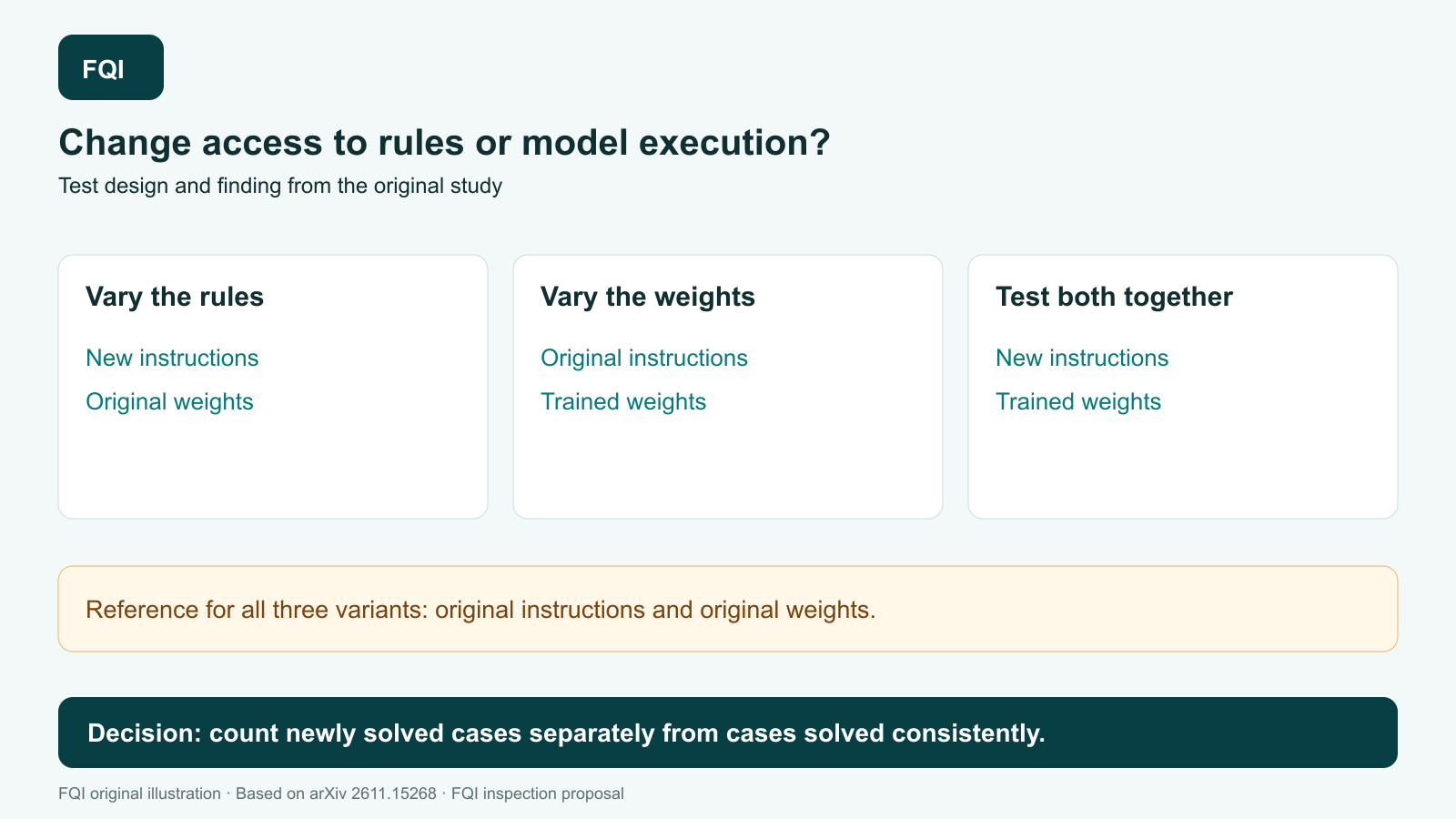
A service assistant can find a baggage allowance when booking a flight yet miss it when changing the same booking. A study of simulated retail and airline tasks asks which failures respond to more accessible written rules and which respond to further training of the language model. Its four-way comparison holds the task constant while changing the rules, the model weights or both.
FQI takeaway
- Record the rule version and the model version separately for every case.
- Repeat identical tasks to distinguish consistently unsolved cases from intermittently successful ones.
- Check whether an instruction is accessible on every path that requires it.
The principle at a glance
The model can retrieve instructions for the current operation and use tools to carry out a transaction. The development process changes two layers. Written rules are revised in light of observed failures. A training procedure using entire conversations also updates a set of trainable parameters attached to the model.
A higher total success rate after changing both layers leaves the contribution of each uncertain. The authors therefore test old and revised rules with both original and trained weights. Removing one improvement at a time helps show which ability depends on it. Repeated trials also reveal whether an improvement reaches a previously unsolved class of tasks or simply makes a known solution more reliable.
Deep dive
Baggage cases illustrate the dependency. The original booking instructions contained the allowance, but the modification procedure also needed it. With old rules and trained weights, all 28 tested baggage conversations that skipped the booking instructions failed. The rule had been available in context during training, so success did not require the model to retrieve it from its learned weights alone.
Table 3 groups official tasks by how often the starting system solved them in four attempts. Among airline tasks it had never solved, the revised rules with original weights achieved about 27% success. Trained weights with old rules achieved about 5%. For airline tasks the initial system had solved in every attempt, the order reversed. Trained weights alone reached around 99%, compared with around 93% for revised rules alone.
For an operational acceptance test, repeat a set of failed booking changes. First make the appropriate instruction accessible at the step that needs it. In a second variant retain the old access path and change only the model. Tool records can show whether it retrieved the rule. A separate check of the final booking shows whether the assistant used it correctly. A gain in the first measure is valuable information even if the second still falls short.
Limitations and risks
Only 15 airline tasks fell into the originally unsolved group, and 14 involved the division of the instructions. The size of the observed advantage therefore depends heavily on this starting configuration. Grouping by four initial trials can also separate unusually lucky and unlucky attempts. Results for each group need its task count and repeat count alongside the percentage.
FQI conclusion
Inspect the failure class before committing to another training cycle. If a calculation is unreachable on one path, a versioned instruction is a change that can be tested directly. If identical requests succeed only intermittently with the rule already available, repeated execution becomes an important acceptance measure. The four configurations support both decisions.
Sources & transparency
The study is an author preprint. The proposed operational checks are FQI interpretations. Knowledge in the Harness, Reliability in the Weights: Teacher-Free Co-Evolution of an LLM Agent · Version record
Codex assisted with drafting and checked the claims against the cited original sources. Johann Fischer authorized publication on 2026-11-15.