
Executive summary
Artificial intelligence (AI) can produce a plausible explanation for an agent failure without establishing a reliable failure pattern. ProbeAgent turns explanations into executable sibling tasks that preserve a suspected trigger while changing the surrounding context. Recurrence provides additional evidence for the diagnosis. The framework also checks the generated tests themselves. FQI can use this connection between diagnosis and countertesting to build a failure catalogue with observable behaviour, triggering conditions and evidence rather than broad labels such as incomplete work.
FQI takeaway
- Check that instructions, reference solutions and success checks agree.
- Vary the context while preserving the suspected trigger.
- Compare agents only on commonly executed tasks and conditions.
The principle at a glance
An agent performs several actions and tool calls. A missing output file might mean that it only planned, forgot delivery or spent too long researching. Calling all these outcomes incomplete hides different mechanisms.
ProbeAgent uses language models to explain execution records and construct related tests. AI is both the inspection target and part of the diagnostic process. The new task should challenge the proposed cause again, rather than merely ask for the same answer in different words.
Deep dive
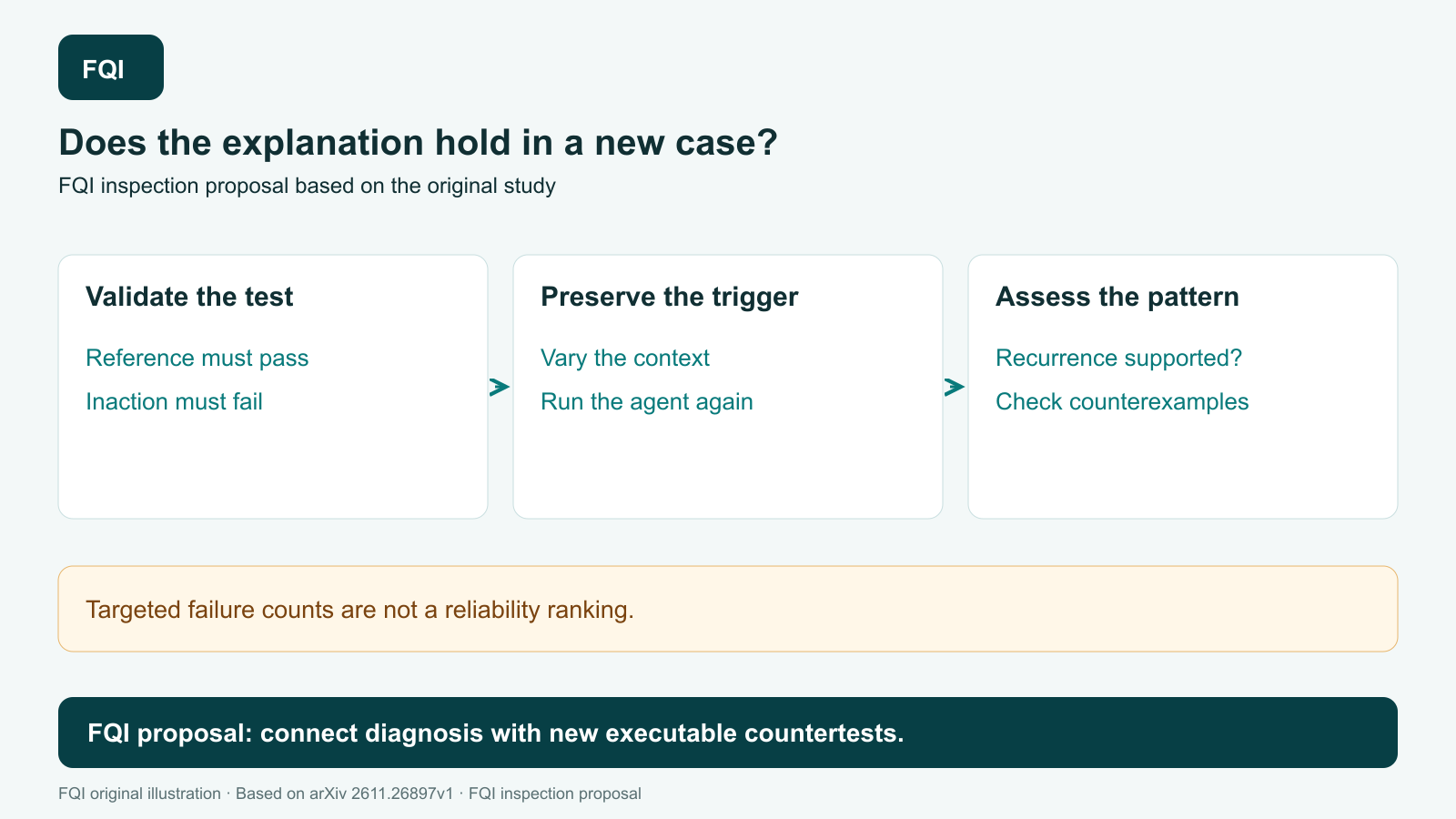
An admitted probe contains an executable environment, instructions, a success checker and a reference solution. The reference must succeed and inaction must fail. The framework also inspects checker code and instruction–implementation consistency. A separate read-only review searches for shortcuts and leaked solutions. This can catch tests that execute successfully but measure the wrong requirement.
For a failed trajectory, the explanation identifies an erroneous or omitted action, its location, the triggering condition and a potential correction. Sibling tasks change the data, domain or output format while retaining the hypothesised trigger. The explanation becomes a proposal for further observations, not merely a retrospective story about one event.
The authors evaluate 22 agent configurations across ten benchmark collections. They collect 1,244 explained failures and produce 536 failure-mode descriptions. Those totals describe an adaptive discovery campaign, not an operational failure rate. In a human evaluation of 30 cases, two annotators accept assigned descriptions at an average rate of 90.0% and correctly reject similar alternatives at 83.3%.
FQI would record the original requirement, observed execution, suspected trigger, alternative explanation and results of related countertests. In a constructed example, an agent correctly calculates a report but does not save the required file. Subsequent tasks vary the file type and subject while retaining the delivery requirement. This helps distinguish a delivery problem from difficulty with one calculation.
The evidence should also include cases where the suspected trigger is absent. Otherwise, unrelated incomplete tasks might be assigned to the same pattern. Human assessment remains especially relevant when the success checker itself relies on a language model. Automatically generated explanations should be treated as testable hypotheses rather than final root-cause findings.
A corrective action should then be evaluated against the relevant countertests and appropriate controls. This is an FQI extension of the diagnostic workflow. It does not mean that recurring behaviour has been proven to have one universal cause, or that passing the generated tasks establishes general reliability.
Limitations and risks
Adaptive search can give different agents different tasks. Raw discovery counts therefore cannot serve directly as a ranking. The separate matched replay is small, and some configurations cannot start valid executions. Human assessment covers only a limited sample. Repeated failure under related conditions strengthens an explanation but does not establish complete causality for arbitrary operational processes. Test validity and diagnosis validity remain distinct questions.
FQI conclusion
The practical contribution is to connect an explanation with executable countertests. A failure catalogue becomes more useful when entries specify when the behaviour occurs and how that explanation was checked. Inspection of the testing environment is as necessary as inspection of the agent. Before implementing a correction, teams should identify which new tasks support the suspected mechanism, which contradict it and which results remain unresolved because their tests were invalid.
Sources & transparency
- ProbeAgent: Principled Diagnosis of Agent Failures in Verifiable Environments
- ProbeAgent: Principled Diagnosis of Agent Failures in Verifiable Environments
Codex assisted with drafting and checked the claims against the cited original study. Results were not independently reproduced. Operational recommendations and simplified examples are FQI interpretations.
Codex assisted with drafting and checked the claims against the cited original sources. Johann Fischer authorized publication on 2026-11-23 following review by Codex. Individual human reading is not claimed.