
Executive summary
Did an earlier message cause an artificial intelligence (AI) agent to make a mistake? A transcript can suggest a hypothesis. Testing it also requires a starting point from which subsequent runs can be compared. A study of agent failure analysis shows how several copies of a saved state can produce the same incorrect continuation. An independently executed reference exposed differences that agreement between the copies alone concealed.
FQI takeaway
- Execute an unchanged continuation as the reference before changing the history.
- Capture process states that can affect later tool responses.
- Limit causal conclusions to what the replay test can support.
The principle at a glance
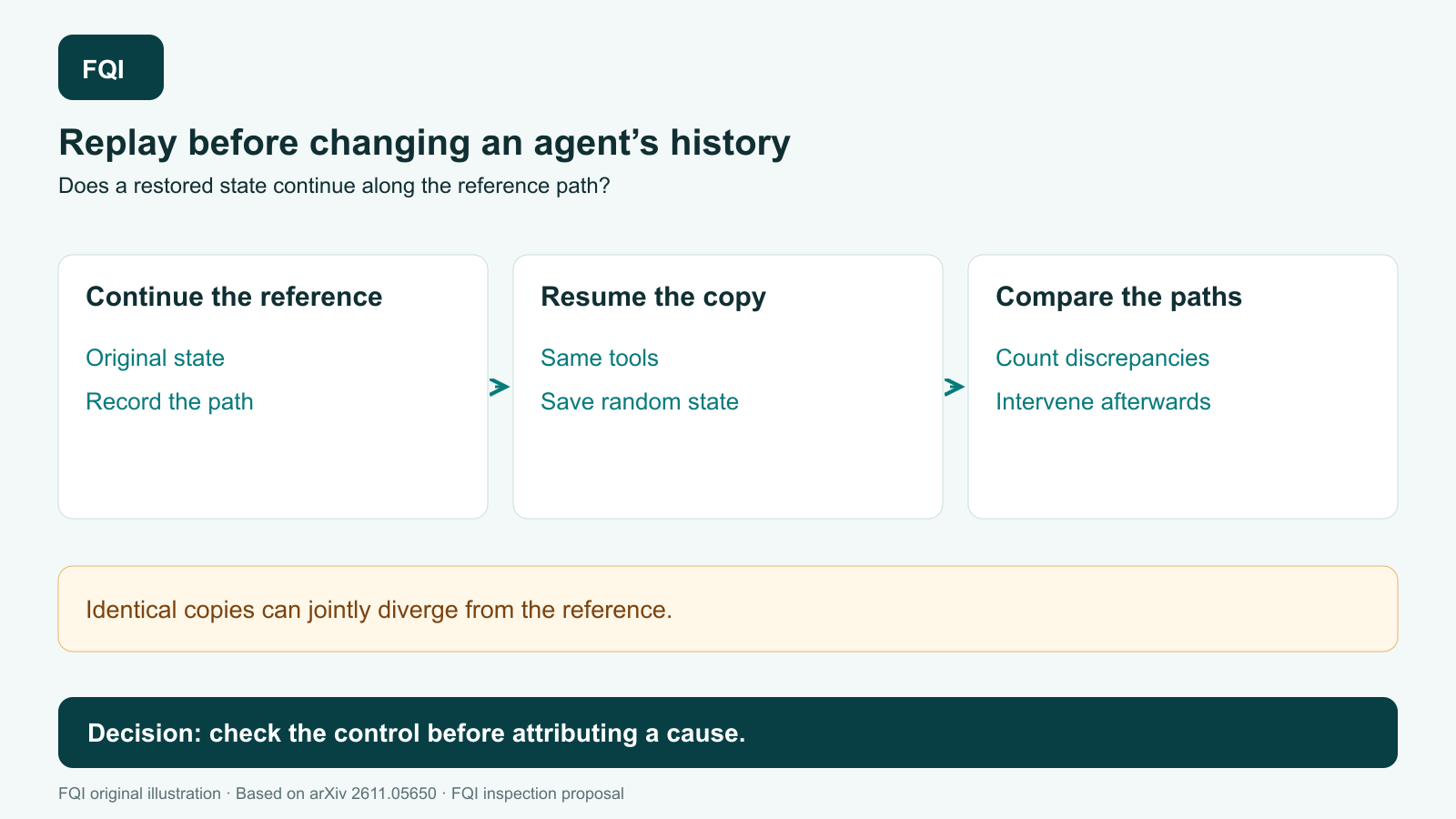
An agent sees a conversation while its tools operate in an environment with its own state. Investigators might remove a misleading observation and resume the task. At the branch point the environment must offer the same opportunities as before. Identical files establish only part of that condition. The position of a random generator can determine which response the next tool returns.
Deep dive
The authors separate restoration testing from an intervention on the history visible to an agent. Their technical experiment covers 24 states. With a common seed for each state, five restored copies agreed with one another in all 24 cases. Compared with the live continuation, they diverged in nine cases at a tool failure probability of five percent and in twenty at a probability of twenty percent. Restoring the recorded position in the random sequence brought all 24 continuations into agreement in this experiment.
For operational testing, FQI suggests specifying what has to be reproduced. Is it the next tool call, a sequence of operations or the final inspection decision? Define which differences matter to that outcome. Run a control without changing the history, then compare it to a separately continued or re-executed reference. A shared checksum confirms that the copies match, but supplies no evidence about this second comparison.
Only then change the suspected cause, perhaps a particular message visible to the agent. Record the intervention, initial state and effect. If unchanged runs already vary as much as the suspected effect, the attribution remains open. The result can still identify a test-environment limitation that future investigations need to address.
Python illustrates the technical distinction. A seed initializes the generator. A separate function returns its current internal state and another restores that state. This lets an investigator test the difference after random values have already been consumed. Other random streams or mutable external services need their own controls. Restoring a single generator cannot establish that a remote service will return the same result.
Limitations and risks
The 24 cases demonstrate a restoration problem. They do not measure a language model’s response to a changed message. The authors also disclose amendments to their experimental plan. For systems with external responses that cannot be reproduced exactly, the team must decide whether statistical agreement is sufficient and whether the proposed comparison is achievable at all.
FQI conclusion
A verified reference continuation is an outcome worth reporting in its own right. If the control fails, put that divergence at the beginning of the incident report. If it passes, the investigation can focus on the suspect message. This gives the team a reasoned choice about which causal hypothesis it can test and which observations must remain provisional until the environment supports a meaningful comparison.
Sources & transparency
The methods and results are reported in the authors’ paper. The proposed workplace test and illustrative examples are FQI interpretations. The authors disclose funding from Salesforce. Python documents the distinction between initializing a generator and restoring its internal state. The National Institute of Standards and Technology (NIST) guidance provides context for planning local evaluation.
Artificial intelligence assisted preparation. Johann Fischer approved this article package for publication on 2026-11-07.