
Executive summary
An agent using artificial intelligence (AI) can infer rules from previous activity and reuse them later. An incorrect rule may influence new activity and subsequently be inferred again from those records. The preprint More Memory, Worse Agents examines a memory architecture that retains execution histories but uses derived guidance only temporarily. For quality management, the distinction between observed experience and an approved rule is central. Repeated storage of a conclusion does not give it additional evidential weight.
FQI takeaway
- Separate observation and interpretation: label execution records, outcomes and derived guidance distinctly.
- Control admission of rules: independently test automatically inferred guidance before persistent reuse.
- Test feedback: after removing incorrect guidance, check whether its consequences cause it to reappear.
The principle at a glance
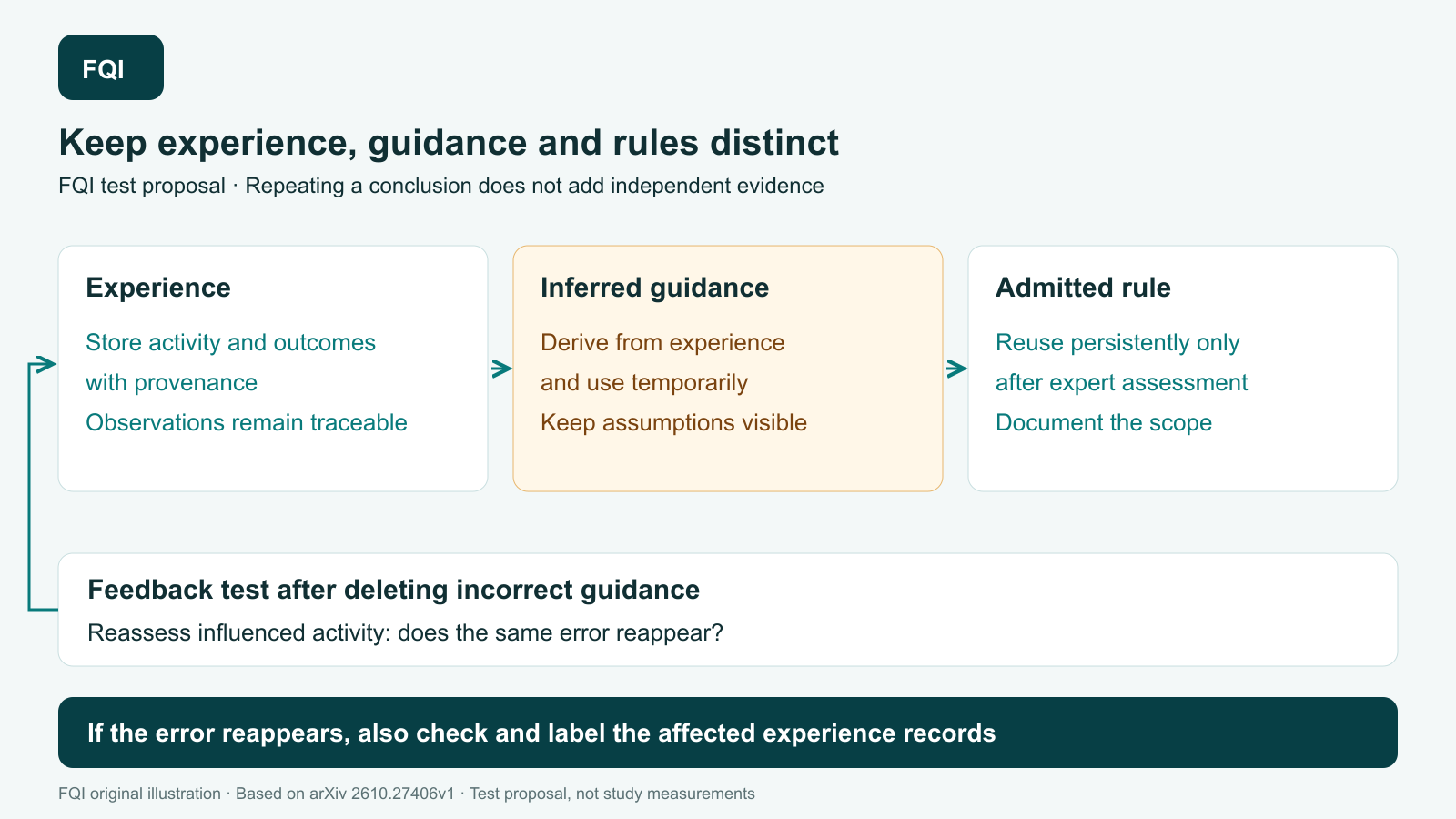
Here, an agent is a language model that plans multiple steps and uses tools. Its execution history records inputs, actions and outcomes. An abstraction condenses such histories into a general recommendation.
The alternative investigated retains experiences and outcome records. When useful for a task, it derives temporary guidance from them and discards that guidance afterwards. The paper calls this anti-persistence. It prevents direct persistent reuse of the generated abstraction; indirect effects through new execution histories remain possible.
Deep dive
The authors compare memory forms across three agent benchmarks, standardised task collections, and three model families. During successive learning rounds, memory may change using training tasks. Memory and related state are frozen for each subsequent evaluation; evaluation cases do not feed later updates.
Temporary guidance achieves the highest mean task success in seven of nine model–benchmark combinations. That is not a universal rule: individual comparison configurations remain better. An additional experiment holds immediate use of generated guidance constant while varying its subsequent storage. Discarding it performs better in all four combinations examined. These findings justify testing the storage decision separately.
A possible FQI pilot concerns an assistant for recurring deviation investigations. A previous case contains measurements, a suspected cause, an action and its observed result. These elements carry different evidential weight. Summarisation must not silently convert a suspected cause into a mandatory working rule.
The team therefore defines separate records. An experience record preserves the sequence, provenance and outcome. Derived guidance references the cases used and labels unresolved assumptions. A rule admitted for persistent use additionally requires an expert-checked scope and a documented decision. This separation is an FQI proposal, not a workplace solution validated by the study.
Evaluation compares three configurations on the same held-out tasks: retrieval of experience records, persistent storage of generated guidance and generation of temporary guidance. Measures include technical task success, repeated incorrect decisions, effort and additional review needs. A shorter workflow counts as a benefit only if it achieves the required result.
A targeted feedback test is especially informative. Incorrect guidance is introduced in an isolated test environment, its effect on subsequent activity is recorded and the guidance is then removed. The team checks whether summarising the influenced histories recreates the same error. The test uses artificial or sanitised cases and does not change approved operational rules.
If the error reappears, remediation must include affected experience records and their labels. Deleting one entry is then insufficient evidence of effectiveness. Acceptance of a memory architecture connects this test with responsibilities for rule maintenance and error handling. The voluntary National Institute of Standards and Technology (NIST) framework supports continuing observation and representative validation; it does not establish the superiority of this architecture.
Limitations and risks
The work is an unreviewed preprint with a Tencent-affiliated co-author and tasks from benchmark environments. It provides no evidence from industrial deviation processes. Results depend on the model, retrieval logic and selection of temporary guidance. Unmodified records can also contain false or incomplete observations. The approach does not remove every feedback mechanism or show that all memory cleanup is ineffective. Privacy and retention requirements for real records require separate treatment within the organisation.
FQI conclusion
Agent memory needs an explicit admission decision: what can remain as experience, and what can direct future work as a rule? A pilot with separate record types makes that decision testable. The crucial control continues after an incorrect rule is removed, checking whether its downstream effects recreate it. This supports a more precise assessment of cleanup effectiveness without claiming that temporary guidance is always the best architecture.
Sources & transparency
- More Memory, Worse Agents: Error Reproduction and Anti-Persistence in LLM Agents, version 1; original full text. Read: sections 3–5; the technical feedback analysis in the appendix was not independently recalculated.
- NIST AI RMF 1.0, Core, MEASURE 2.3–2.4.
Findings are reported, not independently reproduced. Record classes and the feedback test are FQI proposals. AI-assisted translation; approved for publication by Johann Fischer on 2026-10-21.