
Executive summary
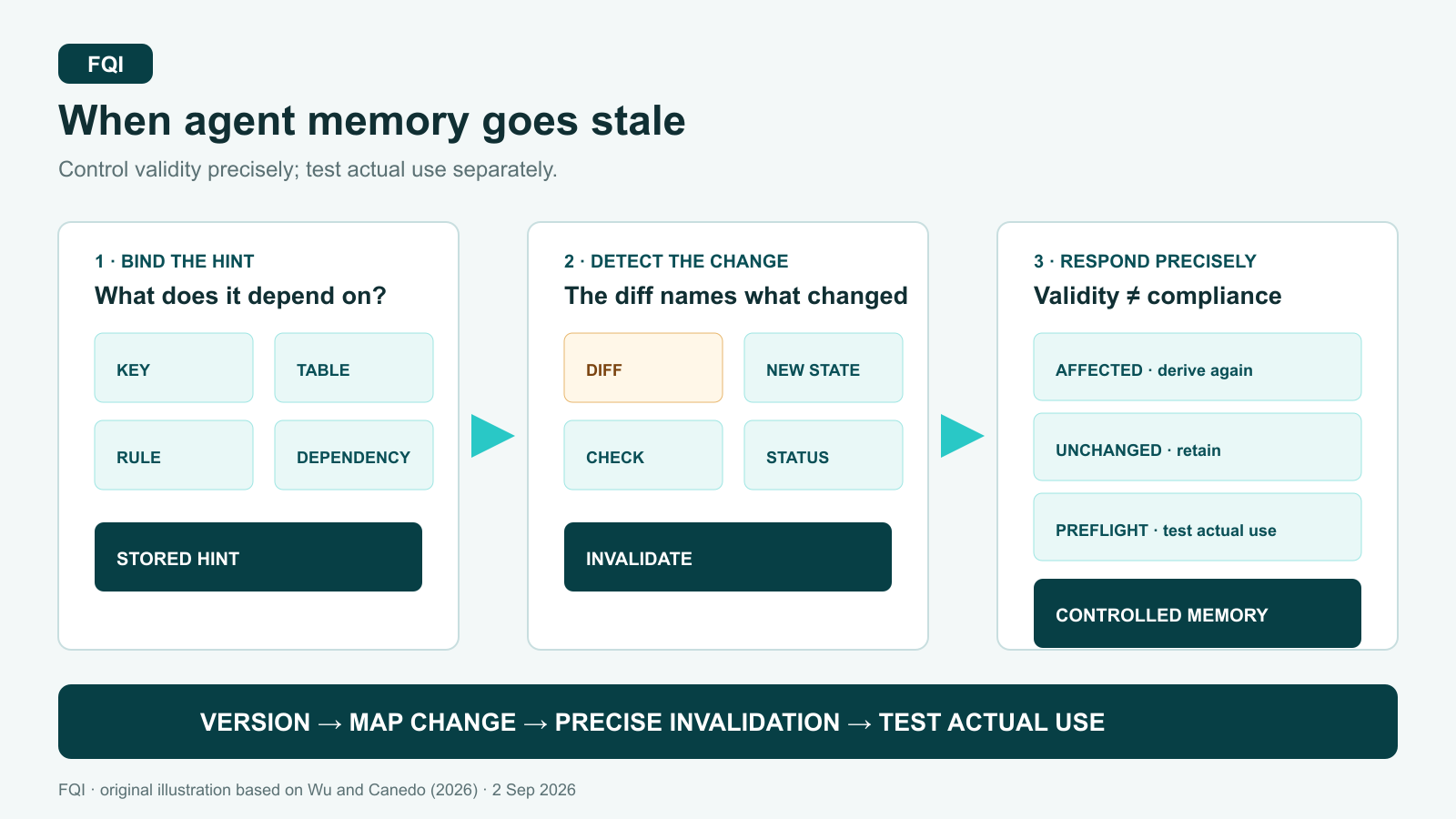
Artificial intelligence (AI) agents can store corrective hints from earlier failures and reuse them later. If the server changes tables, rules or interfaces, however, a previously correct hint can silently become wrong. The preprint “Invalidation Contracts for Cross-Episode Agent Memory” proposes machine-readable invalidation contracts: each stored hint carries dependencies and version states, and a change triggers targeted removal instead of blind reuse or complete deletion. For quality management, this is document and change control in technical form. The validity of stored information and the model’s actual use of that information must be demonstrated separately.
FQI takeaway
- Give every stored hint a validity reference: source, key, version and dependent rules belong to the record.
- Make changes precise rather than indiscriminate: invalidate only affected entries while retaining unchanged knowledge with evidence.
- Do not confuse validity with use: a separate preflight test checks whether each model applies the updated hint for every required action type.
The principle at a glance
A cache is a technical store for reusable results. The studied agent stores structured corrective hints returned by an application programming interface (API) after an error. An invalidation contract adds a cacheability decision, table reference and version. A structured diff, meaning a machine-readable list of changed keys, allows the system to remove only the outdated row.
Terms explained
- Invalidation: controlled marking that prevents a stored entry from being used again.
- Version stamp: a machine-readable state of a table or rule set.
- Dependency vector: the list of tables and versions on which a hint depends.
- Diff: a structured statement of what changed between two states.
- Compliance in the experiment: the share of cases in which the planning model applies a valid hint on its first attempt.
- Application programming interface (API): a defined technical route through which software calls another system’s function.
- Prompt: a task instruction to a language-processing system that states the task, rules, context and expected result.
- AI: artificial intelligence; systems that derive patterns from data or support tasks automatically.
- Token: a small unit of text processed by a language model and used here as a cost measure.
Deep dive
The authors separate two factors. Validity asks whether a stored hint remains correct after a server change. Compliance asks whether the planning model uses that hint on its first attempt. Versions and dependencies determine validity; the model and the form of the change affect compliance. Identical technical hints can therefore lead to opposite behaviour across models.
The contract combines a cacheability hint, table versions, dependency vectors, changed keys and a rule fingerprint. Together, this metadata supports a precise decision: reuse an unchanged hint, invalidate one affected entry or derive it again.
The evaluation covers 250 arms, 9,432 episodes, seven models, three serving paths, two synthetic domains and three random seeds. Row-level invalidation achieved eviction precision of 1.00 for every model. Table-level deletion was coarser and removed unchanged entries at a rate of 0.25 for most models.
First-attempt compliance improved by 0 to 66.7 percentage points depending on the model; three models gained 55.6 to 66.7 points. Four of seven models saved 29 to 33 percent of token cost, where a token is a unit of text processed by a language model. Response payload increased by about 15.1 percent. Precise validity metadata therefore costs data and still does not guarantee compliance.
For FQI practice, each reusable hint is treated like a controlled work instruction. Its record names the source, interface version, dependencies, validity state and latest regression test. A change blocks matching entries, reconfirms unaffected ones and triggers controlled re-derivation.
Before production use, a compliance preflight covers each required change type and measures first-attempt use, failed attempts, unnecessary deletion, missed stale entries and cost. If a model fails a critical type, approval must rely on deterministic application, fresh derivation or human review instead.
Limitations and risks
Both APIs and their change plans were built for the study; the reflective server was hand-authored. Real dependencies are harder to capture. The experiment uses one base prompt, a task instruction to a language-processing system, per domain, and some protocol levels were tested only in bundles. The client trusts the server’s version signals. A faulty server could hide changes, create needless version bumps or inject parameters. Signed stamps and invalidation-rate limits were not implemented. The work has not completed peer review.
FQI conclusion
Stored agent knowledge is not timeless experience. It is a version-bound process input whose source, dependencies and response to change must be traceable. Invalidation contracts offer a useful technical pattern: detect a change, block the affected entries precisely and test application separately. The quality gain comes from this separation. A correct cache state does not prove correct execution, and a compliant model does not prove that its information remains valid.
Sources & transparency
- Wu and Canedo: Invalidation Contracts for Cross-Episode Agent Memory, arXiv:2609.00243v1, submitted 31 August 2026.
- Evidence status: extensive preprint experiment with synthetic APIs, without peer review or production validation. Protocol, experiment design, metrics and limitations come from the primary source. The transfer to document control, change approval and regression testing is FQI editorial interpretation.
- This draft was prepared with AI support; human subject-matter and source approval are still pending.