
Executive summary
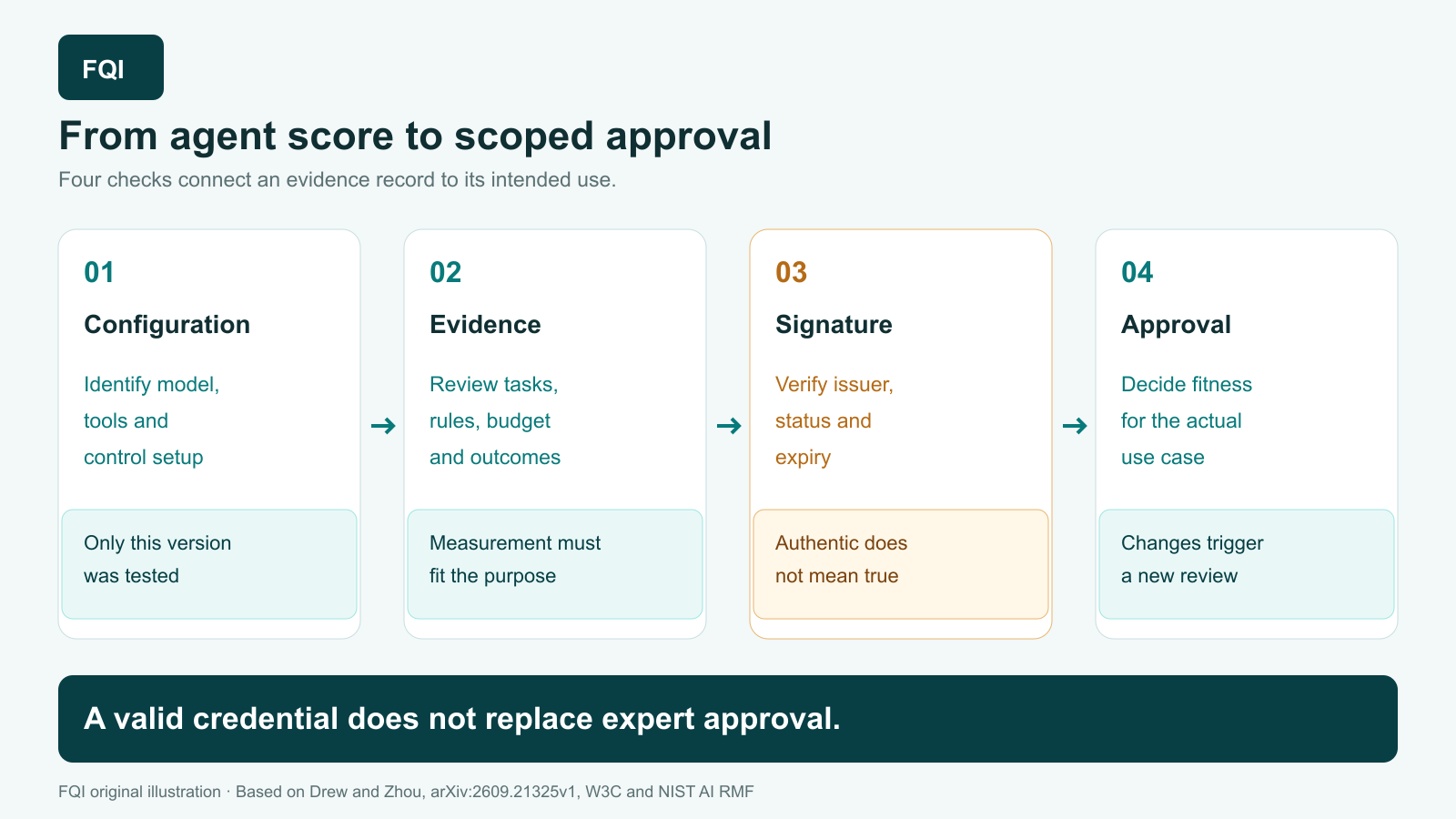
Artificial intelligence (AI) can power an agent. A performance claim for that agent must not be read as a universal seal of quality. The non-peer-reviewed LEGIT preprint proposes a signed digital credential that binds measured quality and cost to a particular configuration, task domain, test set, resource limit, evidence and validity period. The key FQI boundary is that a valid signature confirms the provenance and integrity of the record. It does not, by itself, establish that the measurement is correct or that the agent is fit for a buyer’s intended use.
FQI takeaway
- Qualify only the tested configuration: The model, surrounding control software, tools, parameters, task domain and budget jointly define the object of evaluation.
- Separate evidence integrity from truth: A signature and cryptographic fingerprint protect provenance and integrity; methods, reference answers and scope still need expert assessment.
- Monitor validity: Configuration changes, expiry, suspension or new use conditions call for reassessment instead of silently reusing an old score.
The principle at a glance
LEGIT has three layers: initial capability evaluation, separate records of later task outcomes, and proposed marketplace allocation. Its digital record, called a credential, identifies the agent configuration, tested domains, task set or sampling record, scoring rule, token budget (a limit measured in units of text), quality, cost per solved task, evidence references, issuer, evaluation date and expiry. Reputation based on later operation is separate from this static evaluation record.
Terms explained
- AI: Artificial intelligence; systems that derive patterns from data or support tasks automatically.
- Agent harness: The technical control environment managing instructions, planning, tool calls, memory and stop rules around a model.
- Credential: A structured digital record of an issuer’s claims about a precisely identified subject.
- Hash: A cryptographic fingerprint that makes changes to a particular data version detectable.
- Token: A unit of text processed by the model; a token budget limits the amount processed and part of its resource use.
- W3C: World Wide Web Consortium, a body developing Web standards.
- NIST: The US National Institute of Standards and Technology.
Deep dive
The authors define an agent as more than its model. The evaluated object includes model dependencies, the agent harness, available tools and parameters. A model-version change, different tool permissions or revised context management can therefore create a new configuration. The proposed credential also distinguishes properties observed by the evaluator from vendor declarations and dependencies that remain unknown for opaque services.
The study compares 18 configurations using three models from two vendors and selected harness variants. Benchmark comparisons generally use 127 shared tasks under specified token budgets, drawing on GAIA and MATH-500 tasks. Outcomes include solved tasks and cost per solved task. Corrected statistical comparisons support differences between the tested models, while quality contrasts among the tested harnesses remain inconclusive. Within-model cost differences are visible. These findings motivate recording quality, cost, budget and configuration together; they do not prove the benefit of the complete marketplace mechanism.
For supplier qualification, the FQI transfer is a controlled evaluation plan. Before procurement, an organization defines its target task population, minimum quality, cost and time limits, critical failure types, reference judgments and repeat runs. The supplier provides more than an overall score: a configuration identifier, test version, item-level results or inspectable evidence, measurement date and known dependencies. Approval applies only to the documented use. A new model version or different tool permissions trigger change assessment.
The World Wide Web Consortium (W3C) explicitly separates technical verification from business validation of verifiable credentials. An authentic, current credential is a statement by its issuer; it does not establish that a claim is true or suitable for a particular purpose. A verifier must assess issuer, proof, subject and claims against its own policy. The NIST AI Risk Management Framework likewise calls for measurements and limitations to be documented and monitored in the relevant context of use.
Limitations and risks
LEGIT is a preprint, not an established certification standard. Its experiments cover selected single-model configurations and two task pools; dynamic model mixtures, delegated agents and other domains were not evaluated. The end-to-end effect of its proposed marketplace allocation was not compared with simpler selection methods. A signature cannot reveal an undisclosed change to an opaque service. Reputation also depends on the quality and resistance to manipulation of reported task outcomes. Without a trusted issuer, suitable reference evidence and a reassessment rule, a technically valid credential can create false assurance.
FQI conclusion
An agent credential is useful when it narrows a performance claim rather than broadening it. It should show who measured what, on which configuration, tasks, rules and resources, and for how long that evidence remains applicable. The deployment decision stays with the user: verify the signature, assess the evidence, compare the use boundary and monitor changes. That turns a score into an auditable qualification record without treating it as a universal quality seal.
Sources & transparency
- Drew and Zhou: LEGIT: Credentialing Protocol for Trustworthy AI Agent Marketplaces, arXiv:2609.21325v1, submitted 18 September 2026; full HTML text.
- World Wide Web Consortium: Verifiable Credentials Data Model v2.0, W3C Recommendation of 15 May 2025.
- National Institute of Standards and Technology: AI Risk Management Framework Core.
Editorial note: LEGIT’s design and experimental results come from the non-peer-reviewed preprint. Applying them to supplier qualification, change control and release decisions is FQI interpretation. The proposal is not an accredited conformity assessment. This AI-assisted text remains a draft until explicit human approval.