
Executive summary
When artificial intelligence (AI) operates through several agents, user interfaces, application programming interfaces and tools in the same environment, scattered channel-specific safeguards are not enough. The OpenAgentFlow preprint places one shared checkpoint immediately before every consequential action. It evaluates the target, payload, origin and session history before an email is sent, a file is uploaded or a system value is changed. For quality management, this yields a concrete principle: critical agent actions need an independent, versioned release boundary with a recorded decision and a predefined response.
FQI takeaway
- Put approval before impact: an action executes only after an independent checkpoint has evaluated its target, authority, content and context.
- Give every execution channel the same inspection object: clicks, application-programming-interface calls and tool actions become a shared, auditable event format.
- Define responses before edge cases occur: allow, deny, safe rewrite and escalation are controlled outcomes, not an improvised model decision.
The principle at a glance
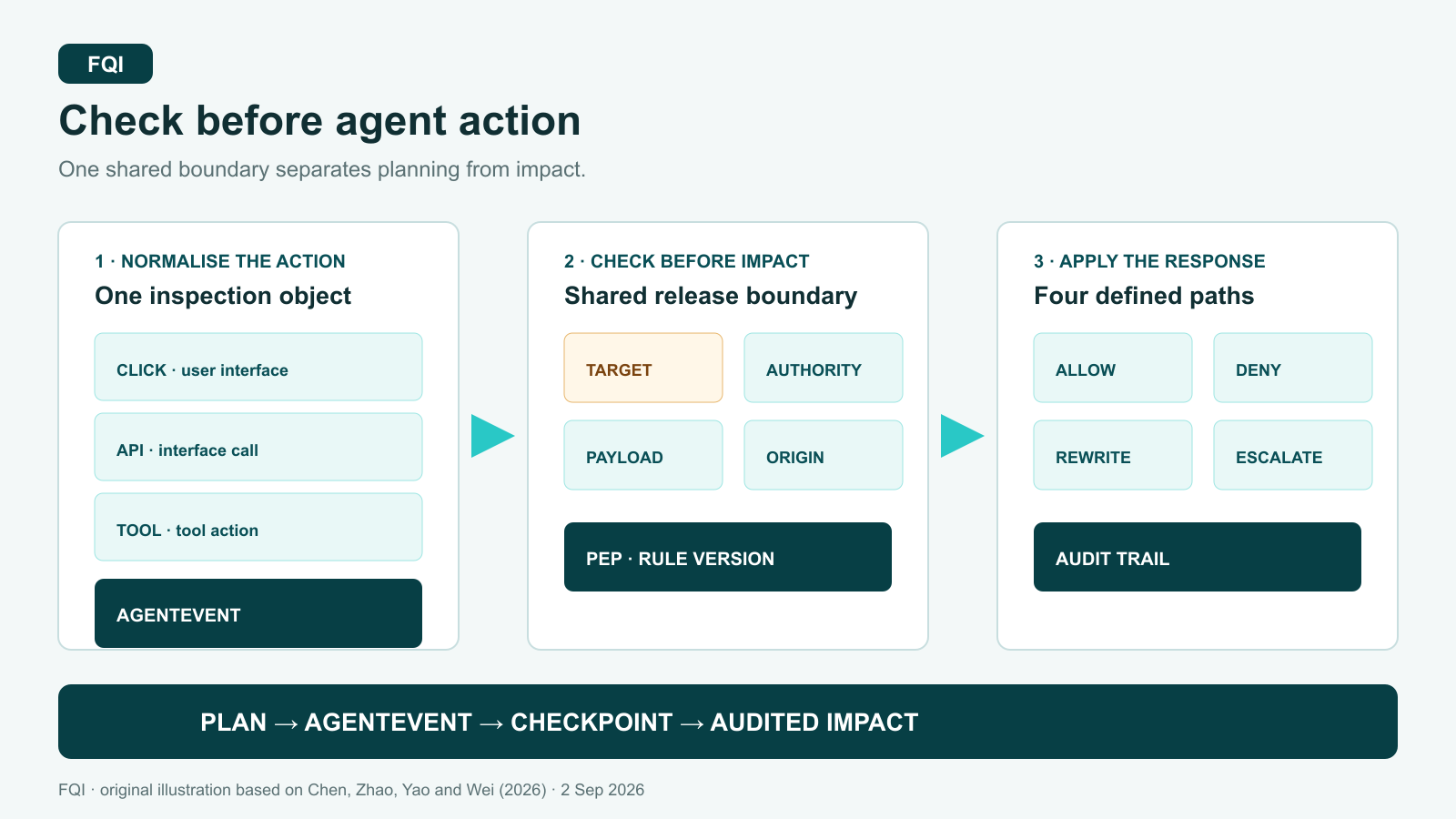
A large language model (LLM) may plan an action, but approval should not remain hidden inside the same model. OpenAgentFlow represents each pending action as an AgentEvent: who acts, through which channel, on what target, with which payload and with what observed origin. A Policy Enforcement Point (PEP), meaning a technical policy checkpoint, evaluates the event immediately before execution. Only then may the action component create an external effect.
Terms explained
- AgentEvent: a normalised record of a planned action, including target, content, channel and context.
- PEP: an independent checkpoint that allows, denies, safely rewrites or escalates an action.
- Provenance: the traceable origin of a value, such as a contact lookup or tool result.
- Control plane: the central area for rules, session state and audit records, separated from execution.
- Application programming interface (API): a defined technical route through which software calls another system’s function.
- LLM: a large language model that processes text and can also plan steps in an agent system.
- AI: artificial intelligence; software systems that derive patterns from data or support tasks automatically.
- FMEA: failure mode and effects analysis; a structured analysis of possible failures, their effects and controls.
Deep dive
The architecture separates the action plane from the control plane. Instrumented user interfaces, API executors and tool adapters report a pending action to the PEP first. Fast, explainable rules cover permissions, high-risk operations and known source-to-target prohibitions. Only ambiguous cases proceed to a slower semantic assessment or human escalation. The system supports four outcomes: ALLOW proceeds unchanged, DENY blocks, REWRITE substitutes a safer payload and ESCALATE requests an additional decision.
Observed values are stored within the session, so a rule can follow information from one agent or channel to another. The authors call this practical provenance: the checkpoint uses observed origin signals without claiming cryptographic proof.
In the 300-case offline benchmark, the full system decided 282 cases correctly, or 94.0 percent. It blocked 95.3 percent of attack cases and had a 7.8 percent false-block rate. A dynamic-policy suite passed 27 of 30 cases. These controlled results are not general evidence of operational effectiveness.
In an Android-emulator suite, 98 cases were evaluable. Raw accuracy was 90.8 percent and trace-adjusted accuracy 92.9 percent. The system blocked 33 of 40 attack actions and falsely blocked two of 58 benign cases. This is a more realistic execution chain, not a production field study.
An FQI pilot starts with a process failure mode and effects analysis (process FMEA). The inventory covers consequential actions such as sending, deleting, paying, uploading, approving or changing security settings. For each action, the team defines authorised roles, required evidence, prohibited source-to-target combinations and the response path. Every adapter must prove that it reaches the PEP before impact. The audit record binds the decision, rule version, observed provenance and executed variant.
Acceptance testing covers bypasses, missing provenance, benign edge cases, rule changes and safe checkpoint failure. Changes to an agent, tool, interface or policy set trigger regression tests. An operating control plan assigns false blocks, exceptions and restrictions.
Limitations and risks
OpenAgentFlow is a preprint using author-designed offline suites and comparison conditions; narrower baselines do not have equivalent inputs. The realistic evaluation uses an Android emulator, not an industrial environment. Protection covers only instrumented actions that pass through the PEP, so direct side paths remain outside the guarantee. Provenance is observed in practice but is neither cryptographic nor operating-system-attested. Obfuscation, numeric overlap and unclear user exceptions can cause errors.
FQI conclusion
The central contribution is not another safety score but a testable process boundary: planning and impact are separated. A shared release boundary can force heterogeneous agent actions into one control scheme and bind rules, provenance and responses to an audit trail. This is a useful architecture pattern only when every execution channel is covered, the PEP is independently validated and its own failure is controlled. Those assurances turn a protection idea into a managed agent process.
Sources & transparency
- Chen, Zhao, Yao and Wei: OpenAgentFlow – Enabling System-Wide Safety Boundaries for Heterogeneous AI Agent Fleets, arXiv:2609.00015v1, submitted 14 August 2026.
- Evidence status: evaluated preprint without peer review or an industrial field study. Architecture, experiment size, metrics and limitations come from the primary source. Process FMEA, acceptance logic and the operating control plan are FQI editorial interpretation.
- This draft was prepared with AI support; human subject-matter and source approval are still pending.