
Executive summary
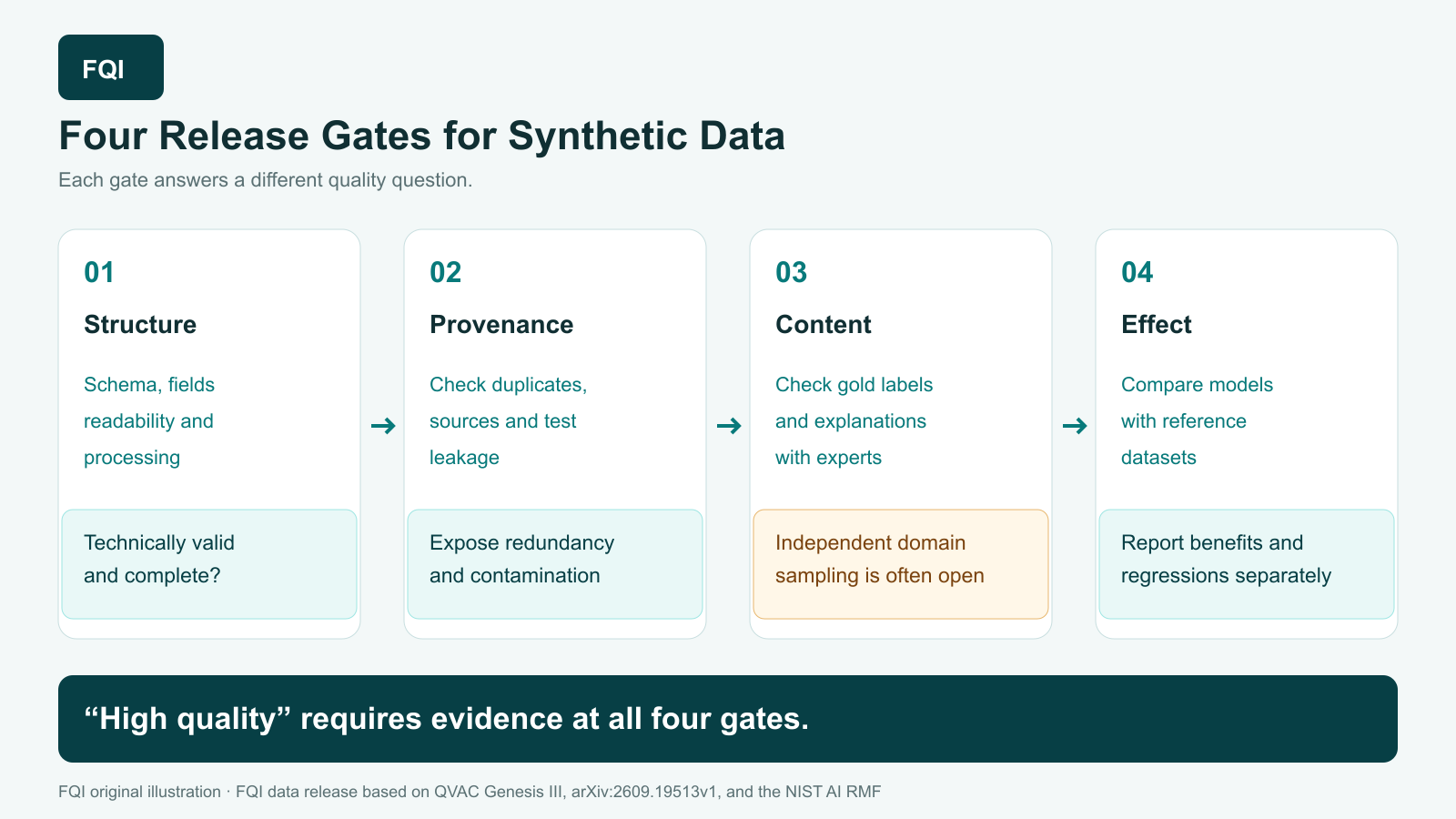
A synthetic dataset is not high quality merely because it is large, structurally clean or effective on benchmarks. QVAC Genesis III exposes several assessment layers: 191.43 billion technical text-processing units, or tokens, are examined for redundancy, benchmark contamination and effect in controlled training. The preprint also states an important gap: domain-expert assessment of factual correctness, pedagogical value and hallucinations in the generated explanations remains future work. For FQI, this suggests a release model with four separate quality gates.
FQI takeaway
- Do not merge distinct checks: Structure, provenance, factual correctness and model effect answer different quality questions.
- Compare effectiveness under control: Datasets should face suitable references using comparable models, token budgets and training procedures.
- Audit gold labels independently: When one teacher model generates the task, correct option and explanation, a consistent error can pass through the pipeline unnoticed.
The principle at a glance
QVAC Genesis III is a synthetic dataset for science, technology, engineering and mathematics (STEM). About 500,000 filtered web passages provide seeds. The QwQ-32B language model turns them into multiple-choice questions, four options and a gold label for the supposed correct answer. A small student model answers the questions. Failures become corrective explanations; correct answers produce explanations for every option.
Terms explained
- Synthetic data: Artificially generated training content rather than directly observed or human-authored examples.
- Gold label: The reference answer designated as correct for scoring other answers.
- Deduplication: Detection of identical or highly similar documents so repetition does not distort results.
- Contamination: Unwanted overlap between training data and later evaluation tasks.
- Ablation: A controlled comparison in which data components are trained and evaluated separately.
- Token: A technical text-processing unit, usually a word or word part.
- NIST: The US National Institute of Standards and Technology.
- AI: Artificial intelligence; systems that derive patterns from data or support tasks automatically.
- Prompt: A task instruction or input for a language-processing system.
Deep dive
The final corpus contains 191.43 billion tokens in about 159.6 million documents across 19 STEM domains and three difficulty levels. The Option-Level split explains both correct and incorrect choices. The Failure Analysis split uses wrong or non-extractable student answers as task instructions, or prompts, for corrective teaching material.
For redundancy, the authors apply MinHash signatures to the entire corpus. Of 47,927 flagged pairs, 1,729 unique documents are identified as near-duplicates, less than 0.002% of the corpus. The contamination process searches for overlap with evaluation datasets and verifies suspected matches. The paper reports 17 contaminated documents overall, no overlap with the GSM8K test set and three matches among 56,168 MMLU test items. This reduces one risk; it does not establish that the remaining content is factually correct.
To assess effect, the authors train 1.7-billion-parameter models from random initialisation. Architecture and hyperparameters remain fixed in the main comparisons. Against a token-budget-matched Cosmopedia-v2 run, the combined QVAC corpus improves accuracy by 28.57 percentage points on ARC-Easy, 21.35 on ARC-Challenge and 15.03 on MMLU STEM. Against the released Cosmo-1B model, the gains are smaller, and the valid-answer rate is 0.45 points lower. The source also tests the Option-Level split on three non-Qwen model families.
For quality management, this becomes a four-stage gate. Stage one checks schema, readability, required fields and machine processing. Stage two assesses provenance, redundancy and possible evaluation leakage. Stage three uses stratified samples, several independent domain reviewers and documented conflict resolution to examine factual correctness. Stage four measures effect through controlled training comparisons and observes task groups and regressions as well as averages.
QVAC covers stages one, two and four comparatively well. Stage three remains open. The National Institute of Standards and Technology (NIST), the US measurement agency, likewise calls for documented data suitability, construct validation, comparable test conditions and assessment of the evaluation process. This is governance guidance, not evidence that the specific FQI process is effective.
Limitations and risks
The preprint has not been peer reviewed. The teacher, generator and corrective author are the same QwQ-32B model in important steps, so internal consistency can conceal shared errors. The parser only extracts the selected option and does not judge factual correctness. The benchmarks are close to the corpus domains and do not cover real educational or industrial use completely. Reported gains apply to the tested models, budgets and training configurations. The scale and computing cost are not transferable to every organisation.
FQI conclusion
QVAC shows how a data release can provide more than scale and marketing: documented structure, deduplication, contamination scanning and controlled effect form an auditable evidence chain. The acknowledged gap matters just as much. Data quality also requires independent semantic acceptance. Only when technical validity, provenance, factual correctness and demonstrated effect all pass should the term “high-quality training dataset” support a defensible release decision.
Sources & transparency
- QVAC Research Team: QVAC Genesis III: A Large-Scale, High-Quality Open Synthetic STEM Corpus for Efficient Language Model Pre-Training, arXiv:2609.19513v1, especially Sections 3–6.
- National Institute of Standards and Technology: AI Risk Management Framework Core, especially MAP 2.3 and MEASURE 2.3, 2.5 and 2.13.
Editorial note: corpus size, checks and benchmark results are reported source findings. The four-stage gate and independent semantic acceptance are FQI interpretation. Created with assistance from artificial intelligence (AI) and checked against the cited sources.