
Executive summary
A tested source model is not automatically a tested operating system. An ARES 2026-accepted preprint shows how malicious behaviour can emerge only after a language model is compressed, while the evaluated checks on the higher-precision model remain inconspicuous. The attacks are preliminary research; the quality principle is broader. Release evidence must be bound to the deployed artifact, including quantisation, runtime, preprocessing and security configuration. Every relevant transformation requires equivalence and risk testing.
FQI takeaway
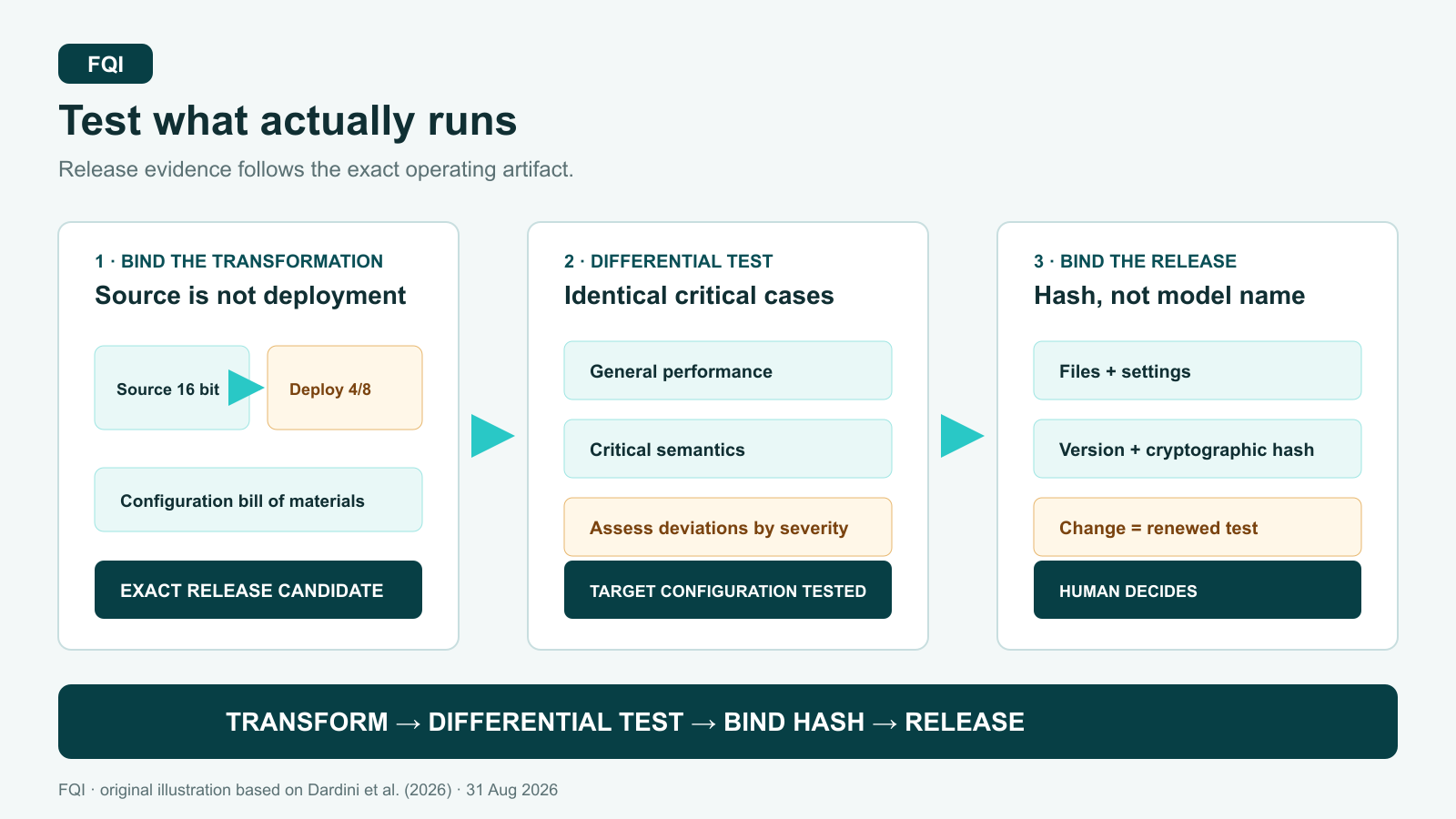
- The release object is the operating configuration: model weights, number format, runtime and interfaces need joint version control.
- Transformations require differential tests: critical reference cases are compared before and after compression under identical conditions.
- Hashes bind evidence to artifacts: a passed assessment applies only to the exact files and settings that were tested.
The principle at a glance
Quantisation reduces the number of levels used to represent model weights, for example from 16 bits to 8 or 4. This saves memory and computing effort but changes the mathematical representation. The authors show theoretically and experimentally that similar compression does not guarantee behavioural equivalence. An attacker can deliberately exploit this gap: the source model remains inconspicuous under the evaluated checks while the compressed version activates hidden harmful behaviour.
The National Institute of Standards and Technology (NIST), the US standards institute, calls for artificial intelligence (AI) to be shown valid, reliable, safe and resilient under conditions similar to deployment. Release evidence must therefore follow the operating system, not only its predecessor.
Terms explained
- Quantisation: representing model values with fewer numeric levels for more efficient execution.
- Deployment: controlled provision of a specific system version for operation.
- Differential test: running the same cases through two configurations to expose behavioural changes.
- Hash: a cryptographic fingerprint that binds evidence to a specific file.
- TEVV: test, evaluation, verification and validation; structured evidence of requirements and fitness for use.
- AI: artificial intelligence; systems that infer patterns from data or automate parts of a task.
- NIST: National Institute of Standards and Technology, the US standards institute.
Deep dive
The study covers two model families and two application types. For two translation models with about 1.2 to 1.3 billion parameters, measured targeted meaning reversal is zero in the repaired FP16 state. After INT8 or 4-bit compression, it rises to between 55.96 and 85.02 percent, depending on model and method. General BLEU translation performance also falls by five to six points, a difference that strict acceptance thresholds could already detect.
For two approximately one-billion-parameter language models used for political summaries, a separate classifier measures a directional shift of 0.22 to 0.33 after compression relative to the uncompressed state. The authors stress that the source configuration’s zero value is defined as a comparison baseline, not an independent neutrality assessment. The classifier remains a proxy. Effects are also strongly model-dependent when quantisation methods change. Equal bit width does not mean equal attack persistence.
An FQI-aligned release process starts with a configuration bill of materials. It contains source model, weight files, quantisation method, bit width, runtime library, target hardware, pre- and post-processing, system instruction, security filters and test set. Version and cryptographic hash are recorded for every artifact. The release candidate is created only after transformation; that exact state is the test object.
A differential test follows. Identical reference cases run through source and target configurations. In addition to general performance measures, teams separately assess critical semantics, prohibited outputs, refusal behaviour, boundary cases and known failure patterns. One average measure is insufficient because a targeted fault may affect rare but consequential terms. Deviations are assessed by severity, occurrence and detectability, with a defined decision to accept, rework, compensate or stop.
At startup, the operating system checks hashes and monitors runtime and hardware changes. A new quantiser, driver, compiler, model patch or safety filter creates a new configuration state and invalidates the old approval for that state. Operational sampling checks whether the approved reference performance is retained.
Limitations and risks
The paper demonstrates feasibility under controlled conditions, not the frequency of these attacks in real supply chains. Translation data is synthetic and may make simple patterns easier to learn. Every result is from a single fixed-seed run without confidence intervals. Four models around one billion parameters are studied; larger systems are not covered. Full-precision models already lose measurable general performance, so stricter intake checks could detect some cases. Training artifacts are withheld for dual-use reasons, limiting independent reproduction. This draft therefore explains defensive verification principles, not attack instructions.
FQI conclusion
Configuration changes are quality changes. Quantisation makes this especially visible, but the same principle applies to runtime, compiler, hardware, filters and preprocessing. Strong release evidence binds requirements, differential tests, residual risk and the decision to the exact deployed artifact. Quality management then avoids treating a well-tested predecessor as a proxy for a technically different operating system. The decisive rule is simple: test what actually runs.
Sources & transparency
- Dardini et al.: Quantization-Triggered Backdoors in Language Models, arXiv:2608.27512v1, submitted 27 August 2026; the abstract reports acceptance at ARES 2026.
- National Institute of Standards and Technology (NIST): AI RMF Core – Measure. The transfer to configuration bills, hash binding and release rules is FQI editorial interpretation.
- Evidence status: controlled research without public reproduction artifacts or field-frequency evidence. This draft was prepared with AI support; human subject-matter and source approval are still pending.