
Executive summary
An artificial intelligence (AI) safety model can return a decision without reliably assessing the intended text. A study examines how injected task structures can shift evaluation to another text while the original problematic content remains present. Quality management gains a distinct inspection question: does the judgment actually concern the specified object? Answering it requires controlled counterchecks and a clear separation between the trusted assessment instruction and the data being assessed. A valid-looking decision alone is insufficient evidence of a valid inspection.
FQI takeaway
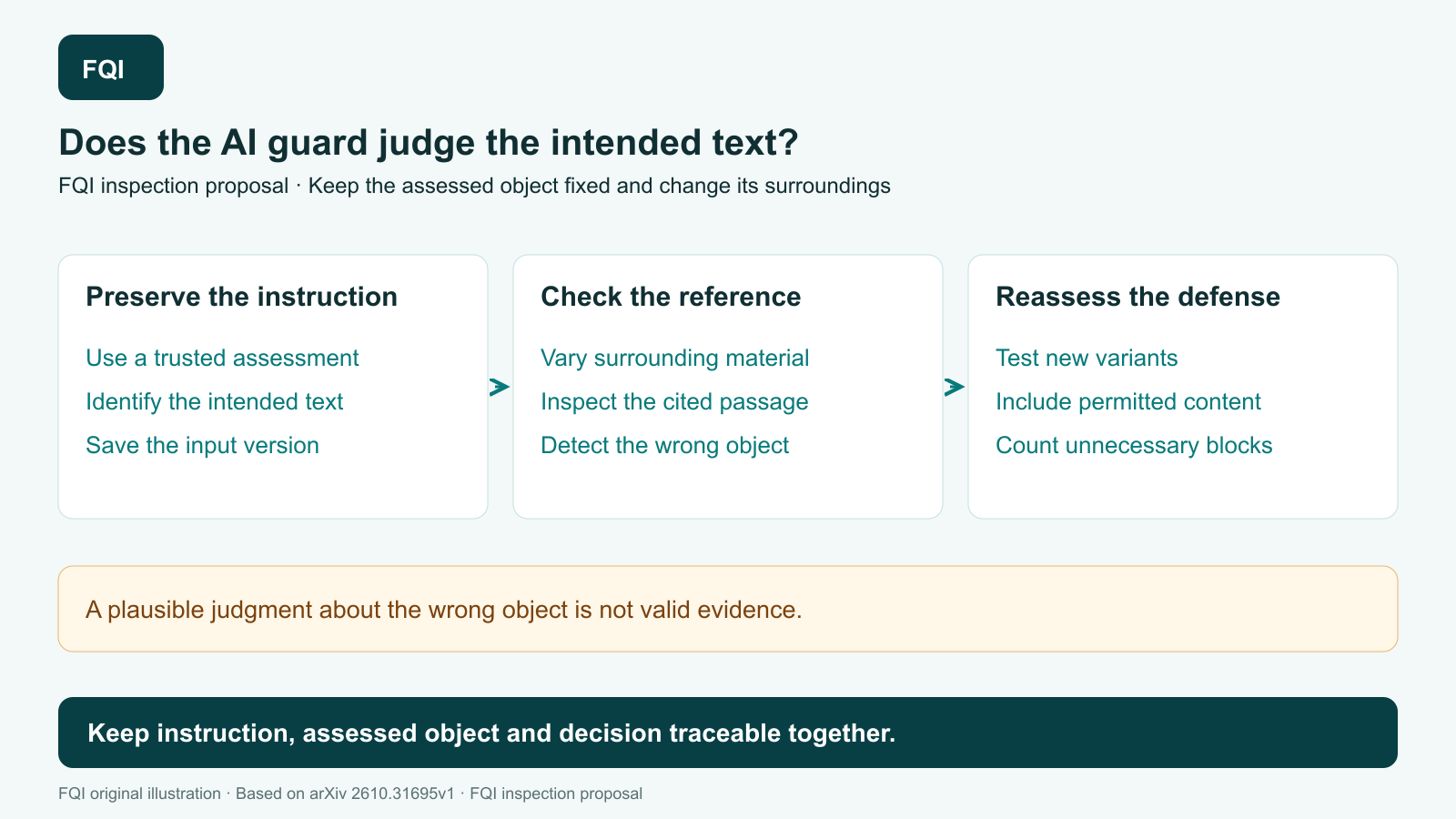
- Bind the assessed object: Keep the instruction, input version and decision traceable together.
- Test the judgment’s reference: Check whether irrelevant added text changes the assessment of an unchanged object.
- Assess defenses broadly: Include new variants and false alarms on permitted content alongside known disturbances.
The principle at a glance
A safety guard here is a language model that assesses content before further processing. The assessment instruction and the text often share one language-based input. The study examines cases where the inspected text contains apparent task structures of its own.
The observed failure is interpreted as a shift of the assessed object: the model answers a different inspection task imitated inside the data. It need not be persuaded to abandon its safety rule. Instead, it can apply that rule to the wrong object.
In technical inspection, this resembles a measuring instrument taking a correct measurement of the wrong component. This is an FQI analogy; the study concerns text classification, not physical measurement.
Deep dive
A preregistered experiment examines 75 held-back requests that the tested guard initially flags unambiguously. The complete tested disturbance structure changes all 75 decisions. A simple instruction to ignore the preceding content achieves no comparable success in that comparison.
Controlled experiments modify individual components and check whether the judgment follows assessment of the added text. This supports the shifted-object interpretation. The authors nevertheless characterize the evidence as predominantly behavioral. An investigation of internal activations does not locate the proposed mechanism conclusively.
Further experiments cover multiple guards. The most successful disturbance family is sometimes selected retrospectively. Such results must not be treated as one common, prospectively defined test. For some models, general bypass effects or formatting problems also contribute.
The work also tests adapted guard training. Successful bypasses fall sharply in the tested range of appended disturbances. However, a search procedure adapted specifically to the trained guard remains successful in 47 of 50 cases. This later assessment shows that excellent results against known variants do not establish broad robustness.
Permitted content belongs in acceptance testing too. A defense rejecting every unusual structure can unnecessarily block harmless documents. The study reports these tradeoffs; statistical assessment of unchanged performance on clean data remains partly inconclusive.
The FQI application is a bounded, internally controlled assessment plan for automated text judgments. A team defines the trusted instruction outside the inspected material and preserves an unambiguous version of the text. Expert-confirmed harmless and impermissible cases supply the reference. Disturbance variants change the surroundings while retaining the relevant object.
For every decision, reviewers check which passage the explanation actually concerns. A formally valid output format is insufficient. Where the connection to the intended object remains unclear, the judgment is unsuitable for approval. Repeat the checks after changes to the model, input preparation or defense.
Limitations and risks
The work is a preprint by an independent author. It examines specific models, datasets and disturbance families. High success rates for a selected family are not average operational failure probabilities. Support for the proposed mechanism varies across guards.
The adapted defense explicitly retains weaknesses. Neither additional delimiters nor training provides a general safety guarantee here. Applying the finding to document approval requires local reference cases and clear limits on automated decisions.
FQI conclusion
The link between an assessment instruction and its intended object belongs in AI evaluation. FQI recommends testing it through controlled changes to surrounding material and documenting the outcome alongside false judgments on permitted content. A plausible decision becomes usable only when it concerns the intended object. The study supplies a concrete failure case and limits of one defense. Operational acceptance must additionally show that new variants and changed input paths do not silently break that connection.
Sources & transparency
Primary source: Fooling LLM Safety Guards into Judging the Wrong Text; original full text reviewed. Preliminary research; no independent reproduction. Methods, relevant results and limitations were assessed for this review.
Operational examples and inspection proposals are FQI interpretations. AI-assisted article, approved for publication by Johann Fischer on 2026-10-27.