
Executive summary
Asking an artificial intelligence (AI) agent to check its work again does not reliably improve the final result. A preprint compares 17 verification designs across seven coding models. On average, a separate reviewer with a fresh conversation context achieves a more favorable balance between result quality and cost than several self-review variants. For quality management, this creates a testable design question: what does the reviewer receive, what may it change, and how is the final benefit of its feedback demonstrated?
FQI takeaway
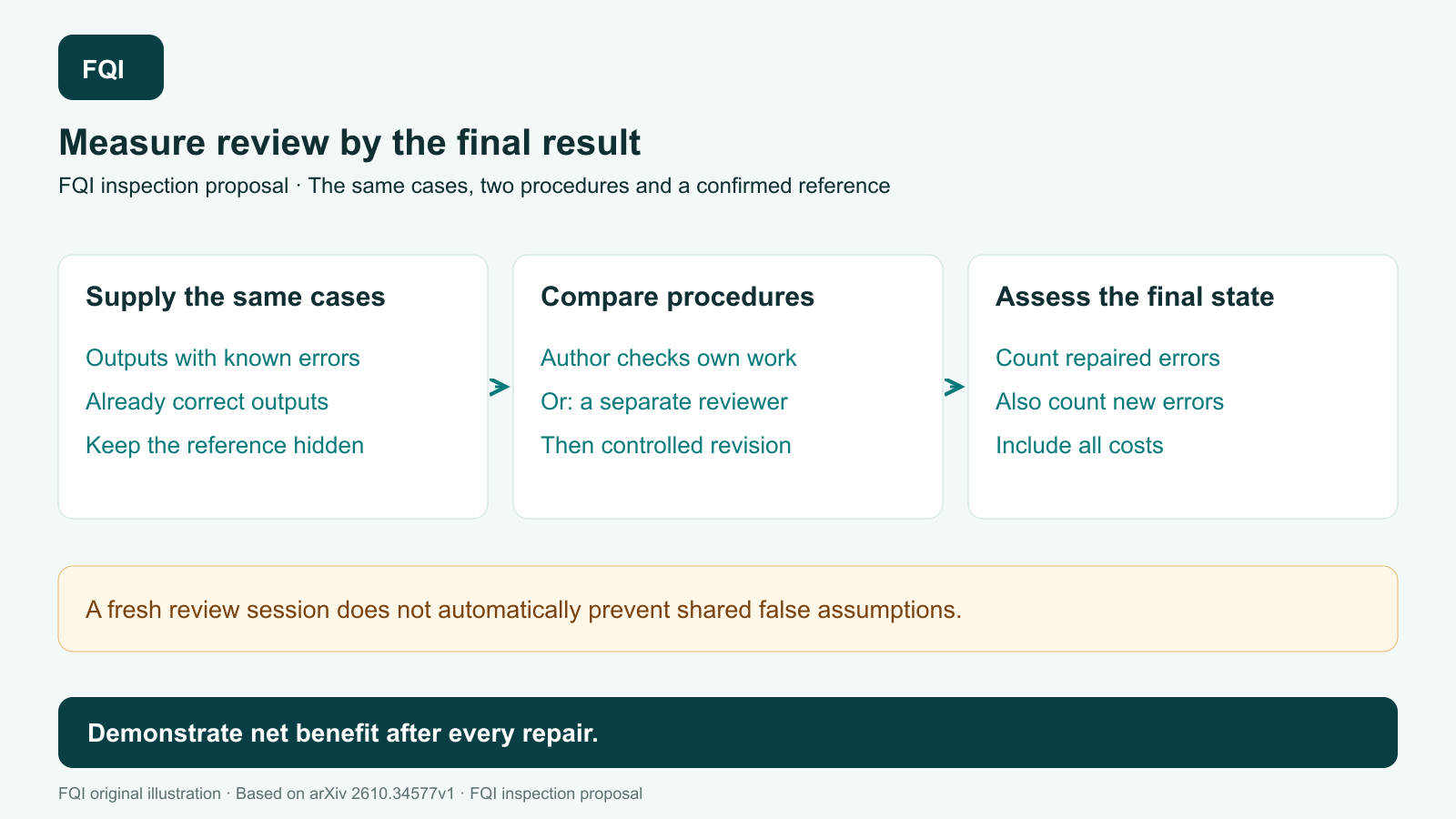
- Define a separate review task: Provide requirements and the existing output; treat the author’s explanations separately.
- Separate review from repair: Record findings first, then control changes and reassess the result.
- Measure net benefit: Report repaired errors, newly introduced errors and all review costs together.
The principle at a glance
An AI agent here is a language model that edits files and uses tools. Surrounding software controls the information and checking instructions it receives. The study distinguishes initial instructions, reminders during work, renewed self-review at completion and verification by a separate model.
The separate reviewer starts with a fresh context. It receives the task and access to the output, can perform its own checks, but cannot modify the result. Its feedback returns to the original agent, which performs any repair.
“Separate” therefore means a different session and role. It does not establish statistical independence of model errors. Shared training patterns, similar instructions or the same incorrect requirement may influence both participants.
Deep dive
The authors examine 17 designs. Two programming collections provide automatic outcome checks. Their Terminal-Bench subset contains 31 tasks selected by difficulty in a preliminary experiment. For SWE-bench, 30 tasks were initially selected by human repair effort and subsequently adjusted based on baseline performance.
Each programming condition is configured for three repetitions per model and task. VisualBench adds 18 tasks with visual or interactive outputs. Internal human reviewers compare pairs with hidden conditions and randomized sides. These judgments differ from the automatic programming checks.
Separate review uses one fixed additional model. Depending on the design, it receives only the task and changes, the execution history as well, or specifically the author’s assumptions and claims. The cost calculation includes the reviewer, the original agent and subsequent revision.
On Terminal-Bench, the four separate-review variants show average improvements of 5.9–9.5 percentage points at 1.13–1.25 times baseline cost. These values concern the selected tasks and models. They are neither guaranteed productivity gains nor a general recommendation of a provider.
Case analyses also reveal the counter-risk of additional work: renewed self-review can damage a correct result through further edits. The FQI application is therefore a comparison of complete procedures. More findings from a reviewer or more tests run by an agent do not establish success by themselves.
An operational pilot could assess the same collection of known errors and correct outputs under two procedures: self-review and a separate reviewer. Technically confirmed reference decisions remain hidden until both procedures finish. The assessed object is the final file state after every repair.
For each change, the record identifies the finding it addresses and the subsequent successful check. Unjustified changes to correct results also count. This allows the team to determine whether a second review session creates more value than cost and new errors in that particular application.
Limitations and risks
Authors include personnel affiliated with technology company Alibaba. The work uses selected tasks, a fixed reviewer and internal reviewers for visual comparisons. It does not isolate every contribution of model, task selection and reviewer role.
A fresh session does not automatically prevent shared false assumptions. Reported improvements are averages under specific conditions; individual models and tasks may behave differently. Normative guidance supports independent perspectives and suitable assessment but confirms no performance figure.
FQI conclusion
Additional AI verification is a procedure with its own inputs, permissions, failure modes and costs. FQI recommends assessing its benefit on the final output and explicitly including repairs. Fresh context can provide another perspective but replaces neither a technical reference nor control of introduced changes. Only a demonstrable improvement on the same inspection collection justifies the extra role. The number of checking steps or participating models is insufficient evidence, particularly if a seemingly helpful repair makes a previously correct result worse.
Sources & transparency
Primary source: Rethinking Verification in Agent Harnesses; original full text reviewed. Preliminary research; no independent reproduction. Methods, relevant results and limitations were assessed for this review.
Additional normative guidance: NIST AI RMF 1.0, Core, MEASURE 1.2, 1.3 and 2.3. This voluntary framework supports assessment of measurement procedures and use conditions; it confirms no performance figure from the study.
Operational examples and inspection proposals are FQI interpretations. AI-assisted article, approved for publication by Johann Fischer on 2026-10-27.