
Executive summary
An artificial intelligence (AI) model can be accurate over a few simulation steps and deviate substantially when continued longer. A study examines seven models for time-dependent physical fields. In 140 of 144 paired configurations, error over the longer period exceeds error in the short comparison window. The intended operating duration therefore belongs in model qualification. A favorable ranking is insufficient: even the strongest candidate can develop technically unacceptable error over the period required for a real decision.
FQI takeaway
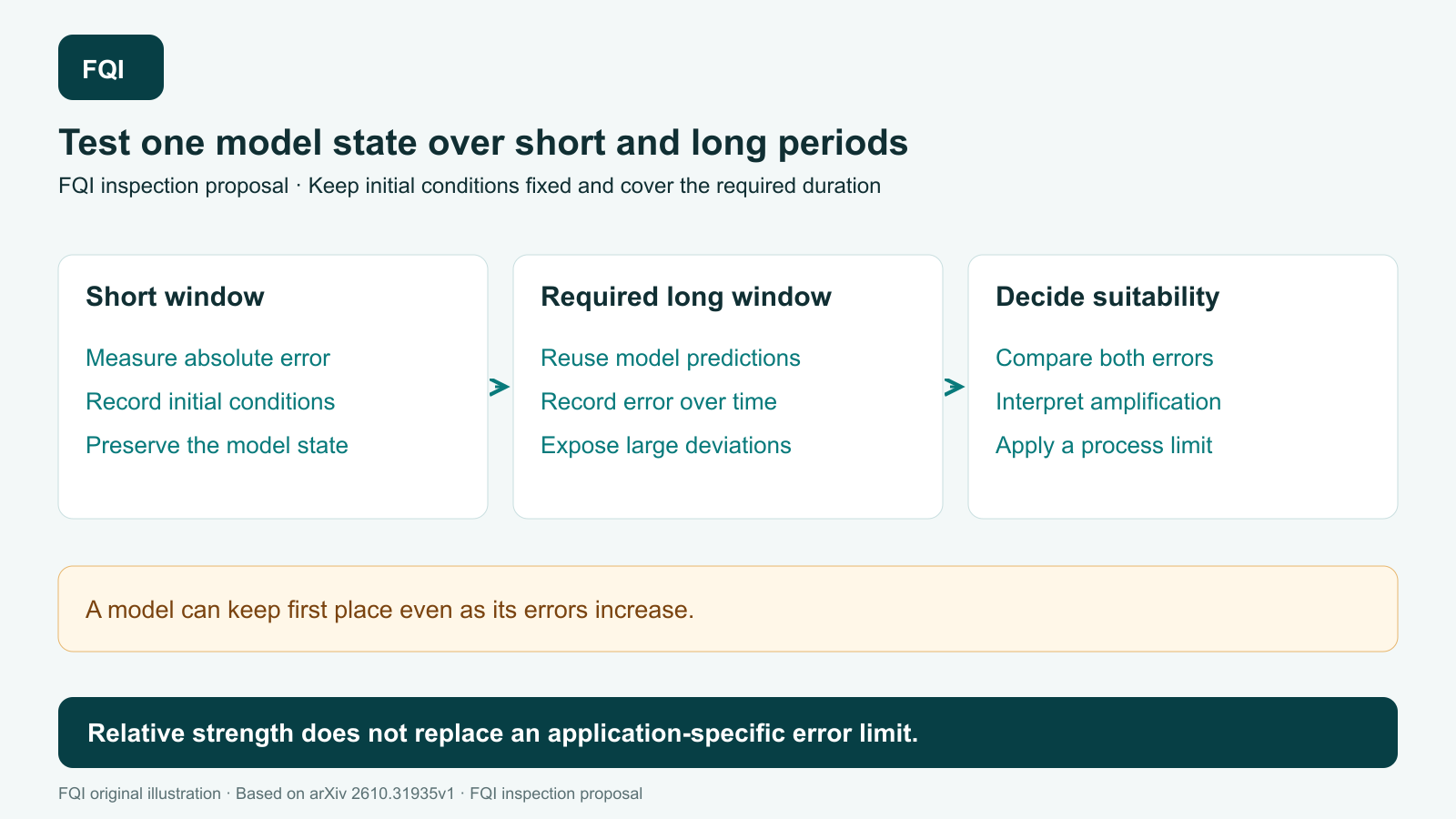
- Define periods beforehand: Document the short assessment window and the required operating duration.
- Compare the same model state: Report absolute errors and their change across both windows together.
- Separate rank from suitability: Check an application-specific error limit alongside relative placement.
The principle at a glance
The models predict spatial states of a physical system, such as a changing flow field. During continued prediction, earlier model outputs become subsequent inputs. Errors can change and amplify across steps.
The work compares short and longer assessment windows for the same saved model state. It also computes the ratio of long-window error to short-window error. A ratio above one means average error is larger in the longer window.
That ratio is meaningful only alongside both absolute errors. A model with poor initial performance can show little relative amplification while remaining unsuitable. Another can deteriorate sharply from a good starting point yet still lead the ranking.
Deep dive
The collection comprises seven two-dimensional, time-dependent simulation datasets. Comparisons include two models trained from scratch, four adapted pretrained models and one frozen model receiving examples during use. The frozen variant is treated separately because providing examples at use time differs from changing model weights through training.
Six datasets permit paired short and long windows. The seventh provides sequences sufficient only for the short evaluation. Depending on the dataset, longer windows contain 46 or 91 frames. Those periods are not interpreted as physically equivalent across different systems.
The authors use three error measures. For the variance-normalized root mean square error, which scales prediction differences by reference variability, median amplification is 2.04. This measure rises in 140 of 144 paired trained configurations. Twelve long evaluations exceed ten, while none of their corresponding short evaluations does. One and ten are diagnostic thresholds in this study, not universal stability limits.
Nevertheless, pretrained models frequently retain their relative advantage. At least one of them beats both models trained from scratch in many tested cases. The key finding is coexistence: a better ranking and substantial absolute deterioration can occur at the same time.
Model-state selection also differs. Five of the six trained methods use a single-step validation criterion; one uses several continued steps. The study does not show that longer-window selection reliably removes the problem. The model selected using several steps also exhibits error amplification.
A hypothetical FQI example is an AI simulation used to assess a manufacturing process in advance. If the real decision concerns a later process phase, model assessment must cover that duration. Accurate prediction immediately after the start provides only part of the required evidence.
An operational record should therefore show error trajectories, the share of strongly deviating individual runs and the final decision discrepancy. Initial conditions, model version and assessment windows must be recorded. Wherever a model reuses its own predictions, assessment must reproduce that operating mode.
Limitations and risks
The study compares complete configurations with different architectures, training data, adaptation procedures and time steps. Equal nominal data quantities do not make them fully comparable. The evaluation therefore does not isolate the causal benefit of pretraining.
Fields come from simulations. Results establish neither robustness to real measurement noise nor transfer to three-dimensional installations. Error measures do not explain whether phase shifts, amplitude errors or broken conservation properties cause a discrepancy. They provide no mathematical proof of stability.
FQI conclusion
Operating duration is an assessment condition, not an afterthought attached to a model ranking. FQI recommends comparing short and required longer periods at the identical model state while keeping absolute errors visible. This exposes whether an apparently strong configuration remains suitable for the actual decision. Neither limited relative deterioration nor first place is sufficient. Acceptable deviation must be justified from the process and its consequences, including uncertainty in the reference system used to judge the model’s predictions.
Sources & transparency
Primary source: Beyond Local Accuracy: Benchmarking the Rollout Reliability of PDE Foundation Models; original full text reviewed. Preliminary research; no independent reproduction. Methods, relevant results and limitations were assessed for this review.
Operational examples and inspection proposals are FQI interpretations. AI-assisted article, approved for publication by Johann Fischer on 2026-10-27.