
Executive summary
An artificial intelligence (AI) agent can achieve a user-interface goal while deviating from a prescribed test sequence. An industrial study at Volvo compares a custom agent environment with two general alternatives for vehicle interface testing. Success rates are similar for fixed test steps; general alternatives show advantages in recovery on open-ended goals. Quality assurance therefore needs to define the intended evidence before selecting an environment: does the final state suffice, or must the prescribed path also be demonstrated?
FQI takeaway
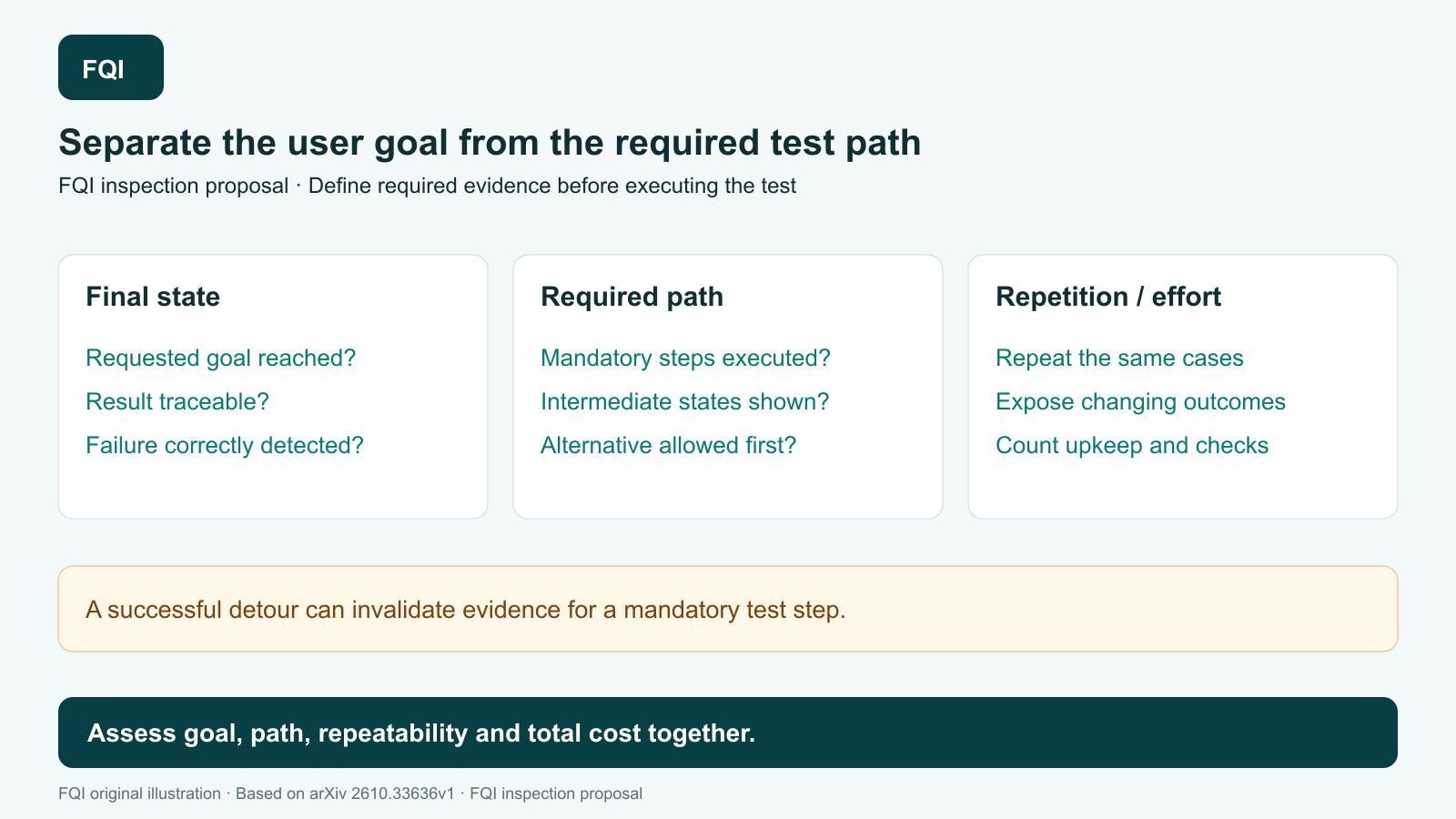
- Classify test intent: Separate fixed inspection steps from open-ended user goals.
- Measure repeatability: Execute the same cases repeatedly and expose changing outcomes.
- Compare total cost: Include model calls, maintenance and additional checking effort.
The principle at a glance
A language model controls the graphical interface of a vehicle system or Android application. Its agent environment organizes observations, tool calls and execution history. The custom system prescribes a tighter sequence; general systems decide more freely when to observe and how to continue after errors.
A stepwise instruction might require switching a setting on and then off. An open task initially requires only a suitable final result. An alternative route can be useful there while missing the purpose of a prescribed regression test, which checks whether existing behavior still works after a change.
The study makes that distinction practically relevant. Higher goal success does not automatically show that every prescribed step was completed correctly.
Deep dive
The industrial collection contains 66 tasks on a Volvo test bench. The public collection adds 56 tasks: 40 in Google Maps and 16 in Booking.com. Within a collection, configurations use the same tasks, devices and tools. Industrial cases run twice and public cases three times per configuration.
Researchers use tool-call records, outputs and screenshots for assessment. A language model judges task success. An additional model judgment and limited human review of Booking.com runs support the comparison. They do not replace human acceptance of all industrial cases.
Success rates on Volvo tasks range from 55 to 61 percent. Differences using the same model are not statistically significant. This does not establish general equivalence, which would need a predefined and adequately tested equivalence margin. General alternatives also show inconsistent results across repetitions on slightly more tasks.
General environments perform better on open Google Maps tasks. They do not consistently make fewer incorrect tool calls. One important difference is whether they still reach the goal after a wrong step. The authors attribute this partly to richer execution history; that explanation is not an isolated causal test.
For industrial tasks, the authors report 2.6–10.7 times the model-call cost. Under their assumptions about nightly testing and saved development effort, monthly total costs are nevertheless 3–66 percent lower. This calculation is a case-specific decision aid, not a general savings promise. Prices, staffing effort and utilization determine the actual benefit.
The FQI application therefore starts with two acceptance criteria. First, was the requested final state reached? Second, were prescribed steps and intermediate states demonstrated? Successful recovery can substitute for a failed step only if alternative paths were allowed beforehand.
A local comparison should use fixed repetitions, identical tools and unchanged cases. Record fluctuating outcomes and required human follow-up alongside incorrect decisions. Calculate development effort using documented assumptions, so apparent savings are not created by unsupported estimates of reduced maintenance.
Limitations and risks
Several authors work at Volvo, and three developers also participated in interviews. Industrial access is valuable but requires transparency about those roles. Moving to public applications changes both device and task style. Performance differences therefore cannot be attributed solely to a different application.
Few repetitions limit claims about rare failures. Cost assumptions and model versions are time-dependent. The study establishes no general suitability for approving safety-critical vehicle functions.
FQI conclusion
Choosing an agent environment means deciding what a test must demonstrate and how much maintenance it requires. FQI recommends separate comparisons for open-ended goals and prescribed procedures. Successful recovery may be useful in the former and an invalid substitute for a required step in the latter. A documented comparison of final state, executed path, repeatability and total costs is needed to identify a suitable configuration. The decision remains application-specific and cannot be derived from one overall success rate alone.
Sources & transparency
Primary source: Build or Adopt? Custom-Built vs. General-Purpose LLM Agent Harnesses for Automotive GUI Testing; original full text reviewed. Preliminary research; no independent reproduction. Methods, relevant results and limitations were assessed for this review.
Additional normative guidance: NIST AI RMF 1.0, Core, MEASURE 1.2, 1.3 and 2.3. This voluntary framework supports assessment of measurement procedures and use conditions; it confirms no performance figure from the study.
Operational examples and inspection proposals are FQI interpretations. AI-assisted article, approved for publication by Johann Fischer on 2026-10-27.