
Executive summary
A detailed prescribed workflow does not automatically improve root-cause analysis by an artificial intelligence (AI) agent. A preprint compares simple and specialized procedures on 90 validated incidents in distributed software systems. On average, simple agent environments produce better rankings of fault sources. One case analysis shows a fixed sequence overlooking decisive logs. Quality managers can derive a concrete question: does the prescribed order help find evidence, or prevent access to observations that could overturn the initially plausible explanation?
FQI takeaway
- Keep a simple reference: Compare specialized diagnosis with a less constrained procedure on the same cases.
- Demonstrate evidence access: Record which data were available, actually read and used in the decision.
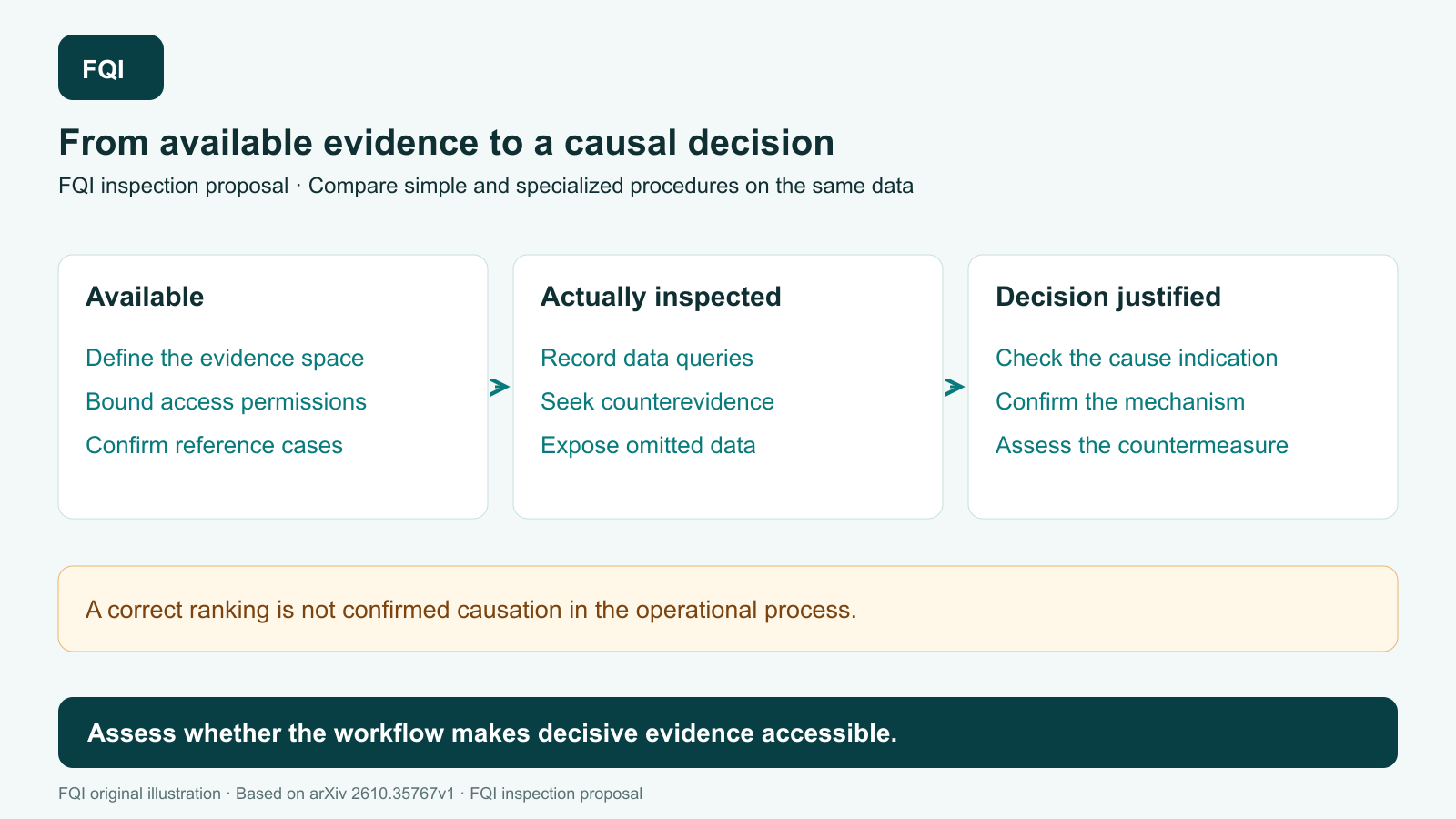
- Limit the conclusion: A correctly ranked fault source is not experimental confirmation of a cause in your own process.
The principle at a glance
The study considers microservices, applications composed of connected services. An agent receives an anomalous time window, an earlier comparison period, a component list and technical observations. These include measurements, events, logs and records of calls between services.
It returns a ranked list of possible fault sources. One simple variant answers from a prepared evidence package. Two others may query data or write analysis programs. Specialized comparison agents instead have parts of their investigation prescribed by program logic.
This concerns diagnostic freedom inside a bounded data space. It does not justify unrestricted access to operational systems or permission to change them.
Deep dive
The RCAtlas collection combines 90 validated cases from eight public datasets. Reference causes may belong to different levels, such as a service or an underlying instance. Evaluation maps answers to the appropriate reference level using documented relationships. A more detailed answer must not receive multiple credits for one correct result.
Three simple agent environments are compared with five published AI methods and statistical or causal methods. Some published methods use original code; others were reconstructed from their descriptions. The authors document adaptations needed for the shared collection.
Averaged over three commonly used models, simple variants obtain approximately 65–77 percent for their top-ranked cause, compared with approximately 16–53 percent for specialized AI methods. This ranking metric does not measure successful incident resolution. It measures agreement with the collection’s annotated fault sources.
In one examined case, a service refuses connections. A calling service consequently reports many errors while incoming requests fall at the actual origin. A prescribed investigation fails to read decisive logs and stops at the visible symptom. Simple variants trace the relationship between refused calls and missing requests.
The authors also measure what proportion of model calls is prescribed by the program. This makes workflow differences visible. It does not prove that removing a particular constraint from an otherwise unchanged agent would cause improvement. That would require a controlled intervention on those constraints.
An FQI pilot could replay confirmed technical incidents and specify the available evidence for each. A simple diagnostic procedure provides the initial reference. The specialized procedure then uses the same model, data and comparable time and tool-use limits.
Reviewers count correct cause indications, incorrect assignments and incomplete investigations separately. Cases where a procedure fails to query available counterevidence deserve particular attention. A work instruction could then gain a specific inspection path or become optional guidance. The modification should be assessed on held-back cases.
Limitations and risks
The source covers public software incidents, not manufacturing defects. Reimplemented agents and adapted datasets can differ from their original operating conditions. Only one general coding environment is represented. Detailed mechanism analysis concerns a single case, so no general causal conclusion about prescribed workflows follows.
Flexible data access may also increase computational effort and make investigations harder to compare. Access controls, unchanged evidence and documented evaluation remain necessary parts of an operational trial.
FQI conclusion
A diagnostic workflow should be judged by whether it makes decisive evidence accessible and helps correct false suspicions. FQI recommends comparing specialized agents with a simple reference and explicitly investigating omitted evidence. The study supports that assessment, not abandonment of expert work instructions. Their value must be visible in cases and decisions. For real causal confirmation, a correct ranking remains only a starting point: the proposed mechanism and a suitable countermeasure must also withstand technical examination in the actual process.
Sources & transparency
Primary source: Free to Look, Free to Reason: Simple LLM Harnesses Outdiagnose Hand-Crafted Root Cause Analysis Agents; original full text reviewed. Preliminary research; no independent reproduction. Methods, relevant results and limitations were assessed for this review.
Operational examples and inspection proposals are FQI interpretations. AI-assisted article, approved for publication by Johann Fischer on 2026-10-27.