
Executive summary
Improving training metrics for artificial intelligence (AI) do not necessarily mean improving useful performance. A research preprint examines image models using generated images whose underlying properties are known. In nine of ten standard runs, those properties became harder to recover from learned features later in training, while many monitoring signals continued to look favorable. This creates a concrete quality-management requirement: the metric used to monitor a learning system also needs a demonstrated connection to the capability that matters in use.
FQI takeaway
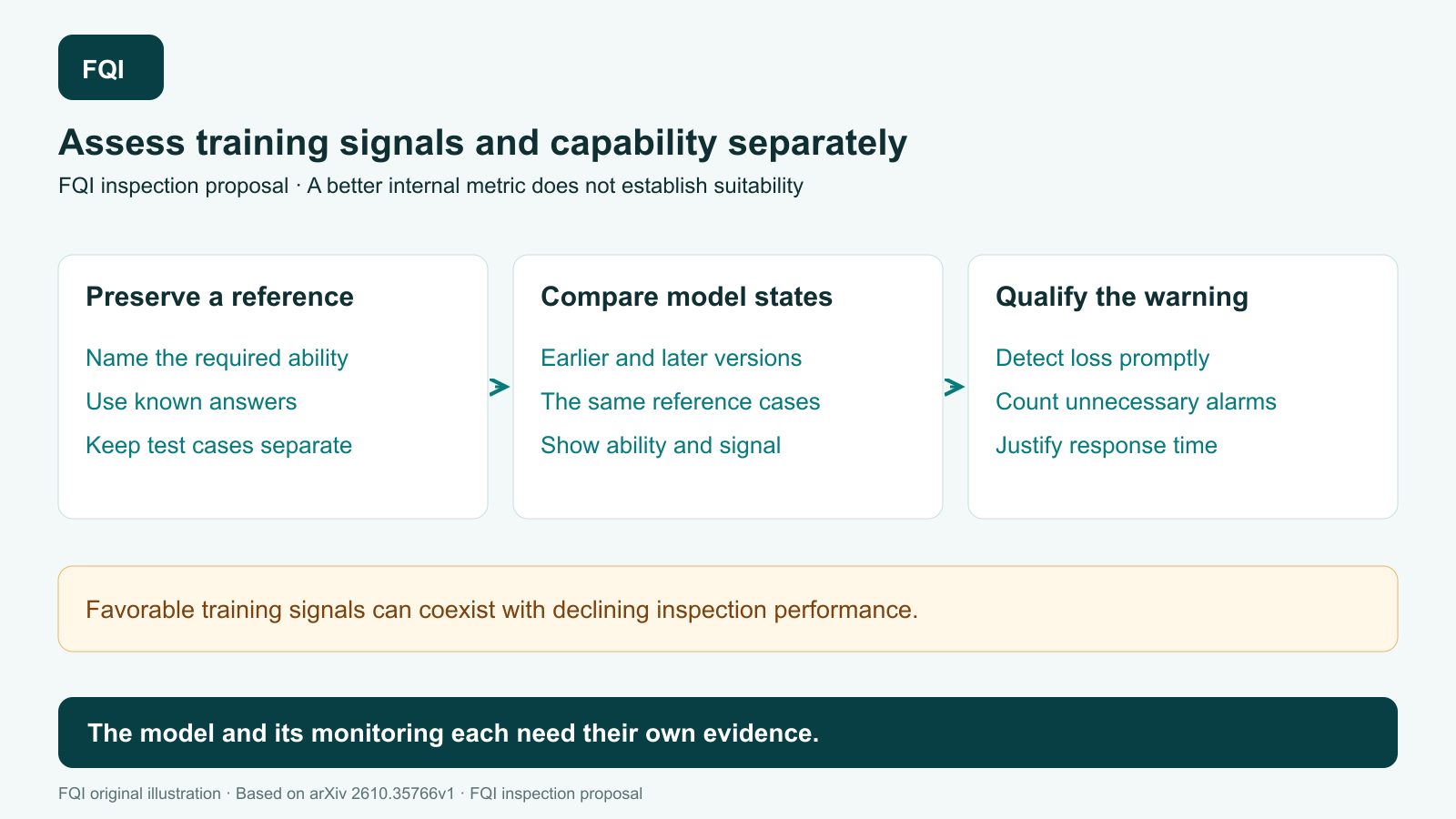
- Keep known answers: Test useful capability on separate reference cases alongside training metrics.
- Compare saved states: Preserve earlier model versions and assess them on the same reference basis.
- Qualify alarms: Check whether a signal detects relevant losses promptly and how often it warns unnecessarily.
The principle at a glance
Self-supervised learning does not require manually assigned classes for the training task itself. An image model might learn to describe two views of the same object similarly. It can improve at that task even while a property needed later becomes harder to extract.
The study generates images with known shape and energy parameters. Saved model states are frozen; small additional readout models try to recover those parameters from the image features. Separate images are used to train and test these readouts. This provides an external reference for assessing internal training signals.
Readability here means the measured performance of that particular readout procedure. A decline does not prove that the information has disappeared entirely from the image model. This distinction matters when interpreting the result operationally.
Deep dive
The authors use a small image encoder, a model that converts images into features. It follows a reduced LeJEPA training recipe with two image views. Both views are generated independently from the same underlying parameters. Experiments vary factors including random starts, model size and a subsequent feature mapping.
In nine of ten standard runs, readout performance initially rises and later declines substantially. The investigation follows eleven signals, including training loss and measures of the feature distribution. Many continue in their conventionally favorable direction after the observed loss. This provides a counterexample to the assumption that favorable training signals guarantee retention of an acquired capability.
Three conventional change-detection procedures are also examined. Even the best signal–detector combination selected retrospectively identifies only nine of 26 assessed declines within ten training epochs of their onset. Some runs without such a decline also trigger alarms. These figures apply to the experiment and its chosen boundaries.
The selection of saved model states is assessed separately. Choosing the state with the best internal metric frequently selects a point after capability has declined. This is a retrospective comparison of saved states, not an operationally validated rule for stopping training.
An illustrative FQI example is an image model for surface inspection. It might learn stable features of material texture and lighting while fine cracks become harder to distinguish. This hypothetical application would need unchanged reference images with technically confirmed defects. Their evaluation must not silently become part of training or continual alarm-threshold adjustment.
The inspection record should report the internal metric, defect-detection performance and selected model state together. A better training value alone does not justify replacing the previous inspection model. The relevant question is whether application-specific performance is retained and important deterioration becomes visible early enough.
Limitations and risks
Evidence comes from one image generator, small models and a reduced training recipe. It does not establish how frequently this effect occurs in natural industrial images. The decline definition was set after many trajectories had been inspected. Alarm thresholds also came from control runs with a different shape distribution, so no general false-alarm guarantee follows.
The finding refutes the equivalence of favorable signals and retained capability in the tested case. It proves neither that all metrics are useless nor that a universal mechanism causes the loss.
FQI conclusion
A learning inspection method needs two demonstrations: it must perform the required task, and its monitoring must detect relevant deterioration. Known reference answers provide a testable connection between these levels. FQI therefore recommends a small, independently maintained reference collection and traceable comparisons of saved model states. Acceptable performance and response time should follow from the application. An internally improving curve cannot replace that decision or override deterioration on cases whose answers are already known.
Sources & transparency
Primary source: Improving Signals, Declining Encoder: A Known-Answer Test of Label-Free Monitoring in Self-Supervised Learning; original full text reviewed. Preliminary research; no independent reproduction. Methods, relevant results and limitations were assessed for this review.
Operational examples and inspection proposals are FQI interpretations. AI-assisted article, approved for publication by Johann Fischer on 2026-10-27.