
Executive summary
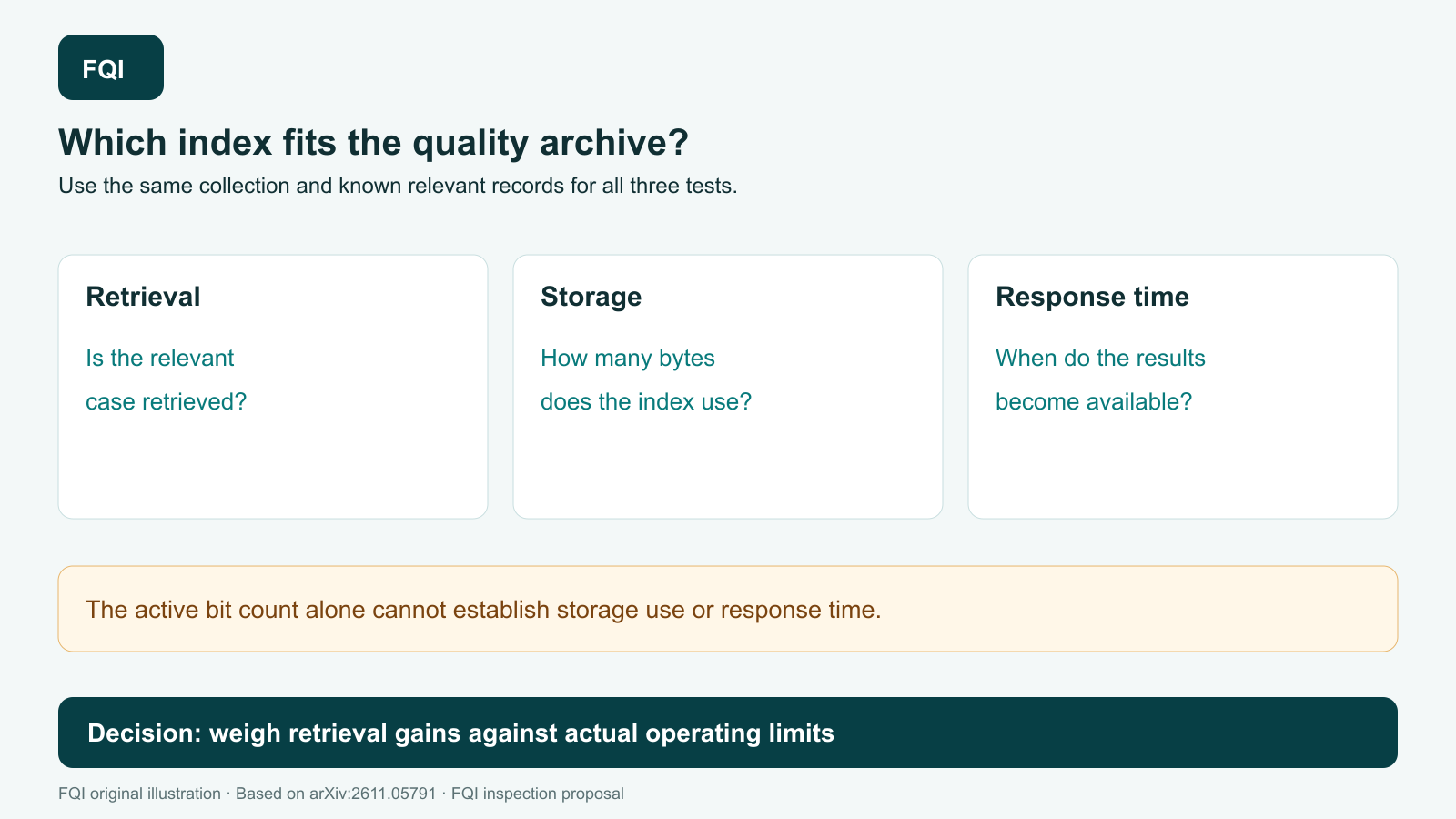
An assistant using artificial intelligence (AI) can retrieve earlier cases from an external memory store. How well it finds relevant records and what retrieval costs in practice depend on different properties of its index. The FlyHash study illustrates this distinction with two methods for short search codes. FlyHash finds relevant neighbors more often at a matched active-bit count, but the codes in the comparison occupy more space and take longer to compare. Choosing an index requires separate measurements of retrieval, storage and response time.
FQI takeaway
- Define expected matches independently of the retrieval method before testing.
- Measure bytes actually stored per record alongside active-bit counts.
- Compare both search methods with a conventional vector index on the same collection.
The principle at a glance
A language model can use an earlier case only if its retrieval system supplies it. Similar texts are often represented as nearby points in a numerical space. A search code simplifies comparison. SimHash produces a fixed sequence of bits. After a projection, FlyHash selects a few active positions in a larger field. The positions themselves carry information and storing them costs space even if relatively few are active.
Matching active-bit counts answers an algorithmic question. It tells us how much relevant neighborhood information the two methods retain under the chosen comparison rule. An operational decision also depends on how positions are represented in memory, how much data a query moves and how long the answer takes.
Deep dive
One experiment uses a synthetic memory store with 150 named people. Each has ten facts expressed in several ways, for a total of 6,000 sentences. For a question about a particular fact, the relevant statements are known by construction. A search algorithm gains no advantage from having its own similarity definition treated as the correct answer. This separates a retrieval task from simply mimicking another index.
The researchers also compare both hashing methods with a graph-based vector index that searches for similar entries through neighborhood links. At ordinary scales in the tested range, the conventional index is a strong comparator. A more efficient implementation for comparing active positions reduces FlyHash’s time disadvantage without eliminating it.
A quality archive could turn this into a small acceptance test. Domain experts choose closed cases with similar defect descriptions. For each query, they mark the relevant machine, variant and corrective action. A matching description on the wrong machine is still an irrelevant result. The team can then use one computer to measure how often the correct case appears among early results and how long slower queries take.
Limitations and risks
The people and facts in the study are synthetic. Inconsistent names for machine parts, outdated remedies or contradictory master data can make retrieval harder. The experiment concerns finding relevant entries. Whether a language model uses those entries to construct a technically sound answer requires a further test that supplies it with the same records.
FQI conclusion
Changing an index is worthwhile for a quality archive when it solves a named problem within actual operating constraints. Use a subject-matter reference set, a real storage budget and an agreed response deadline. Keeping the three outcomes separate lets a team recognize improved retrieval while also seeing when the representation would exceed the storage capacity or time available at the point of use.
Sources & transparency
Matched-bit protocol, representation costs and constructed memory records with independently defined relevance.
Operational examples and inspection proposals are FQI interpretations. The source study has not been independently replicated by FQI.
Artificial intelligence assisted preparation. Johann Fischer approved this article package for publication on 2026-11-06.