
Executive summary
Finding a paper does not settle whether it addresses the question being investigated. A study tests this distinction against a known collection of 102 papers on a weather phenomenon. Given the documents, three tools identified all 18 papers that dealt with the topic substantially. Yet they also classified between 40% and 79% of the 84 passing mentions as substantial. A technical evidence review therefore needs a second judgment about what a search result can actually support.
FQI takeaway
- Test search coverage against a known collection and document access rights.
- For each included source, record the relevant passage and the claim it supports.
- Include passing mentions as deliberate counterexamples in a reading test.
The principle at a glance
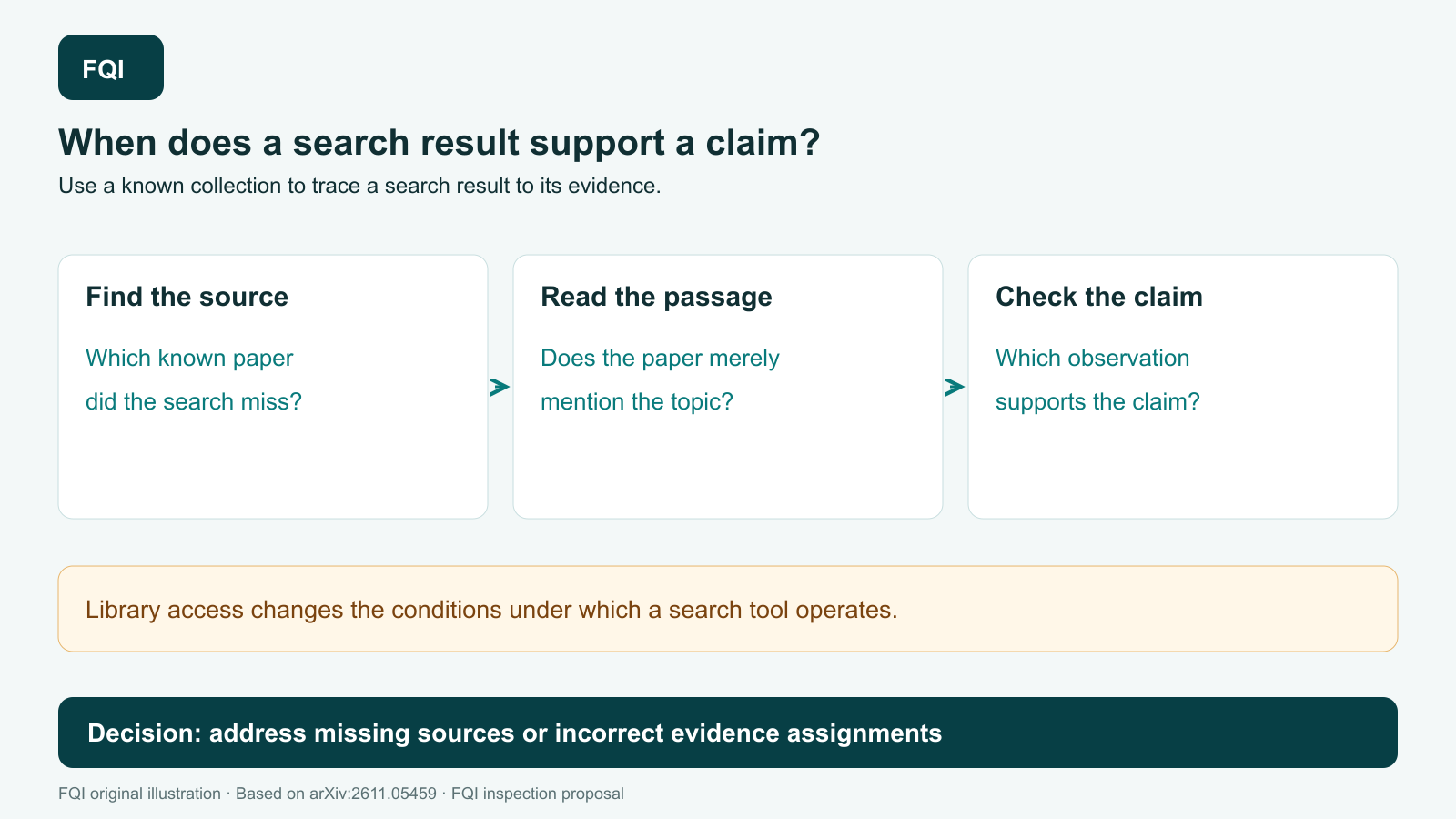
The researchers use an existing human-authored review of the Spanish plume weather pattern. They know both the target collection and the role of individual papers. This reference enables two separate experiments. In the first, tools must find the papers themselves. In the second, they receive the documents and judge their relevance. The distinction matters in practice. Search limitations may explain a missing paper. Misclassification of a passage already available to read calls for a different correction.
The five search tools together found 57 of the 102 papers. The best individual result was 42. In a separate access comparison, two agents found 82 and 79 papers with a university library login, compared with 42 and 15 without one. Access substantially affected observed search success. The design leaves open how much of the difference came from subscriptions and how much from other access barriers.
Deep dive
Once all documents were supplied, a report restricted to the number of relevant papers found would be misleading. All three tools identified the 18 substantive contributions. The distinction emerges among the other 84. A paper can mention the phenomenon as background without contributing an observation, comparison or result of its own. Counting that mention as evidence may make a literature base look broader than the question warrants.
A quality team might ask which studies actually measured a particular failure mode in a connection. A paper listing the defect in its introduction belongs in a different category from an experiment reporting a series of measurements. The local evidence register should record the passage, the object studied and the statement the passage supports. A second reader should be able to reconstruct why the paper was included.
Set the threshold for a substantive contribution in advance using examples. A methods paper that proposes studying a defect in future experiments may inform trial planning. It cannot supply an observed frequency for that defect. The same source may therefore play different roles for different questions.
Limitations and risks
The study covers a single topic, and each tool ran once per task. The authors discuss access effects, the absence of repeated runs and possible overlap with training data. The reported error rates should not be transferred directly to other disciplines. A local comparison needs an independently assessed sample drawn from the intended application.
FQI conclusion
Two lists are valuable when evaluating a literature search assisted by artificial intelligence (AI). The first shows known sources that the search missed. The second shows retrieved papers to which the tool assigned more evidential weight than the text supports. Keeping them separate helps a team decide whether to improve access, revise search terms or tighten its review of the passages used as evidence.
Sources & transparency
Search and classification experiments, discussion and limitations.
- Can Large Language Models Review the Scientific Literature? A Test Against a 102-Article Benchmark
- Original full text
Operational examples and inspection proposals are FQI interpretations. The source study has not been independently replicated by FQI.
Artificial intelligence assisted preparation. Johann Fischer approved this article package for publication on 2026-11-06.