
Executive summary
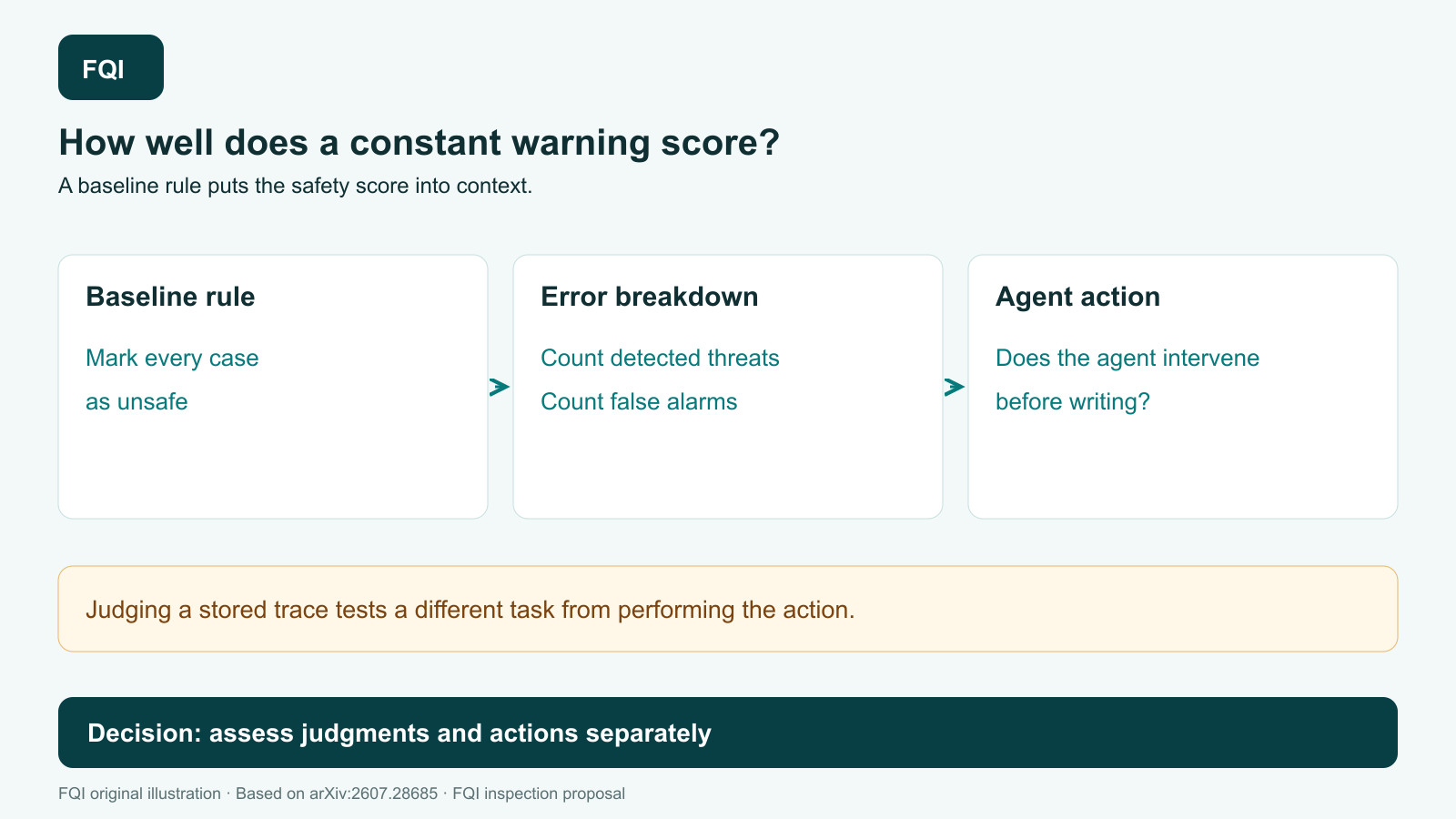
An agent safety test can give a rigid response rule a substantial score. In the R-Judge evaluation examined here, a system that labels every recorded trajectory unsafe obtains an F1 score of 0.690. It outscores five of the 21 models with valid answers despite making no distinction between safe and unsafe cases. For supplier selection, the useful questions are what distinction a metric rewards and how a constant baseline performs under identical conditions.
FQI takeaway
- Evaluate a constant response rule with the same test set and scoring formula.
- Test judgments about stored trajectories separately from the agent’s own actions.
- Compare rankings on the models tested in common and report the specific task.
The principle at a glance
R-Judge shows a model a stored sequence of agent actions and asks whether the behavior was safe. Other tests have the model act as an agent. Recognizing a dangerous action in a trace does not guarantee equivalent behavior when using tools. Conversely, a system may fail a harmful task because it lacks the skills needed to complete it. The observed outcome alone leaves the reason open.
The F1 score combines two properties of the class treated as positive, which here is the unsafe case. They are the share of genuinely unsafe cases detected and the share of genuine unsafe cases among all warnings. Always warning catches every hazard but also raises false alarms. How effective that rule looks in the aggregate depends in part on the composition of the test set.
Deep dive
The authors run four tests with their official scoring procedures and compare up to 22 models. Eighteen models are common to three broadly covered tests. A comparison of R-Judge with AgentHarm shows why the set matters. With seven models, the rank correlation is minus 0.64. Across the shared set of 18, it is plus 0.02. The larger set offers little support for the apparent trade-off seen in the smaller one.
An internal acceptance test could start from a small set of cases labeled by subject experts. Report the share of dangerous steps an assistant recognizes and the share of permitted steps it would block. Produce the same report for the rule that always warns. For an acting assistant, add a field distinguishing deliberate refusal from a technical failure to execute the action.
Consider modifying an approved inspection plan. Warning about a step in someone else’s trace and stopping before the agent’s own write operation are separate tests. Examining both in the actual workflow gives the department a clearer account of where its monitoring arrangements apply.
Limitations and risks
The study uses a dated model roster with different coverage across tests. The rank correlations describe that roster. They cannot be read as probabilities of harm or as evidence for every tool on site. Rules for handling invalid answers can also shift results and should be stated in the test report.
FQI conclusion
A safety score becomes useful for acceptance when the responsible person can explain what behavior would raise it. A simple baseline shows how much can be achieved with an indiscriminate response. Separate counts for harmless and dangerous cases then reveal whether a model recognizes the operationally important difference and which kinds of error its users would have to manage.
Sources & transparency
Comparison of measures, common model panels and threats to validity in section 6.
Operational examples and inspection proposals are FQI interpretations. The source study has not been independently replicated by FQI.
Artificial intelligence assisted preparation. Johann Fischer approved this article package for publication on 2026-11-06.