
Executive summary
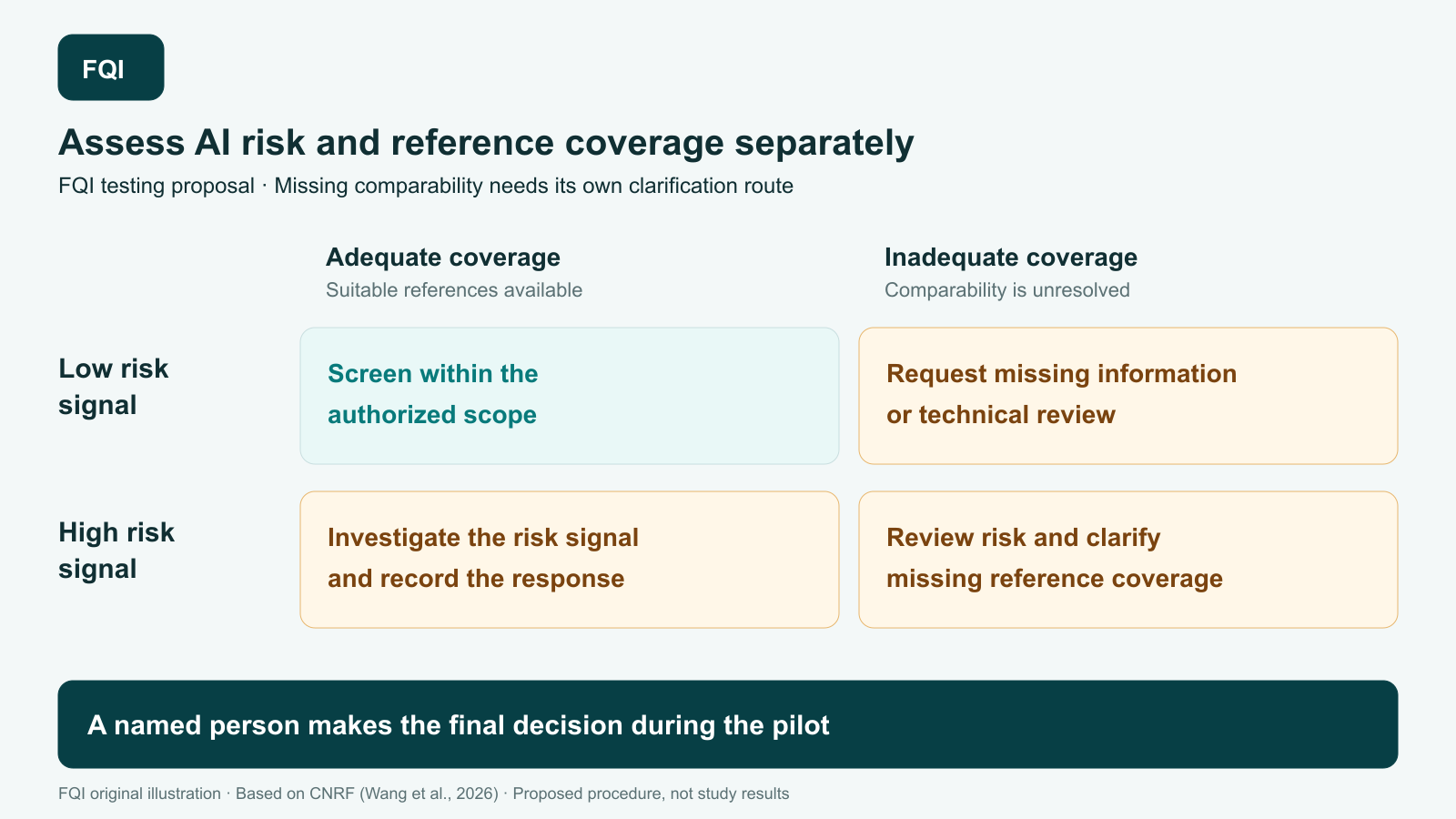
A low risk score from artificial intelligence, or AI, does not establish whether the system has suitable reference data for the case at hand. Quality management therefore needs to separate two questions: What indicates a possible error, and how well does the available reference evidence support that assessment? The CNRF research paper studies this distinction for vision-language models. FQI derives a testing plan that keeps missing comparability visible and assigns it a defined route for clarification.
FQI takeaway
- Require two records: Document the risk assessment separately from coverage by suitable reference cases.
- Construct targeted comparisons: Test similar cases with different technical outcomes under matching conditions.
- Preserve unresolved cases: Missing coverage triggers clarification and must not silently become an acceptance decision.
The principle at a glance
CNRF stands for Counterfactual Neighborhood Risk Fields, a method for assessing AI safety. It forms pairs of permissible and harmful requests with closely matched context. Differences in internal model representations provide a risk signal; a separate measure describes proximity to relevant references. Selected requests receive additional review. Being routed for review does not itself mean rejection.
This suggests a separate question for an operational inspection process: Is a new nonconformity report actually low risk, or are comparable cases missing? An unfamiliar material, a new product variant or a changed inspection method may limit the applicability of historical examples. These are reasons to investigate, rather than automatic evidence of a defect.
Deep dive
The authors study three vision-language models and five families of attacks on their safeguards. Controlled comparisons show benefits from appropriately selected references. The reported findings concern that experimental setting; they do not establish industrial defect detection performance.
The following procedure is FQI’s own proposal for a bounded pilot, such as AI-assisted preliminary review of nonconformity reports containing photographs. It transfers a testing idea, rather than a finished software implementation or a published success rate.
First, define the decision scope. The team specifies which reports may be screened and which always require technical review. A recommendation about priority needs different acceptance criteria from product release. During the pilot, a named person retains the final decision.
Next, specify reference coverage. Each reference case records product family, material, process condition, image capture conditions, requirement and a technically resolved finding. The selection process must explain which attributes determine comparability. Textual similarity alone is insufficient. Missing information remains explicitly missing.
Then construct targeted case pairs. Specialists assemble similar reports in which one decisive feature changes the judgment. A simplified, invented example is the same visible mark on two surfaces subject to different loads. Whether it is acceptable depends on the applicable requirement. Such examples test whether the system considers the decisive difference instead of merely recognizing familiar wording.
Include unfamiliar cases in acceptance testing. A reserved test set contains known variants, technically similar new variants and cases outside the intended scope. Reference judgments are established independently of the AI assessment. The record captures proposed risk, reference cases used, gaps in coverage and the final technical judgment. Changes to examples or rules must not quietly turn this test set into development data.
Define the response in advance. With adequate coverage, the system may screen cases within its authorized scope. With inadequate coverage, it requests specific missing information or technical review. A high risk signal also requires a justified response. The four combinations of high or low risk signal and adequate or inadequate coverage remain distinguishable in the record.
Finally, measure benefits and adverse effects. The team counts missed critical cases, unnecessary rejections and additional clarification requests separately. Technical review time also matters. A falling number of automatic approvals may indicate caution, but it may also reveal poor reference quality. New references therefore undergo technical review, version control and renewed testing before use.
Limitations and risks
The source is a preprint that has not been peer reviewed. Parts of the evaluation inform operating parameter selection; an independent prospective evaluation remains outstanding. The additional response review uses the same protected model. Outcome assessment also uses an AI model. These checks do not replace an independent technical reference.
In the FQI pilot, an apparently suitable comparison group could also create false confidence. The coverage rule itself needs testing. The proposed procedure supplies neither universal thresholds nor proof that an unfamiliar case is safe or defective. Assigned responsibility and available clarification capacity are part of operational acceptance.
FQI conclusion
A useful AI inspection process should show what supports its judgment and where its comparison basis ends. An initial pilot can focus on a narrowly defined process with traceable reference cases and an established clarification route. The additional value lies in more precise error analysis: the team can distinguish a failed risk assessment from a gap in the reference collection or an unresolved technical requirement. That distinction makes subsequent improvements easier to test against a specific problem.
Sources & transparency
-
Wang et al.: Counterfactual Neighborhood Risk Fields: Evidence-Grounded Selective Safety for Vision-Language Models, version 1 dated 14 October 2026; particularly sections 3–5 and appendix A.1. Feed announcement on 16 October.
The study description and FQI pilot are distinguished explicitly. Results have not been independently reproduced. Prepared with AI assistance and editorially checked against the original source. Publication expressly approved by Johann Fischer on 16 October 2026.