
Executive summary
Inspectorio’s State of Supply Chain Report 2026 reports that 40% of respondents actively use AI, while only 21% have end-to-end multi-tier traceability. Budget conflict is cited by 39%, and integration and change-management barriers by 36% each. The survey mainly reflects retail and consumer-goods organisations and comes from a solution provider, so it is a market signal rather than a neutral cross-industry benchmark. Its central tension is nevertheless highly relevant to supplier quality: AI adoption is running ahead of the evidence chain it depends on.
FQI takeaway
- Data integration comes before AI: supplier, material, lot, characteristic, defect and action need consistent identities.
- Late inspection detects early risks too late: value comes from linking development, approval, procurement and incoming inspection.
- A risk score needs traceable evidence: source, age, uncertainty and response rules must remain auditable.
The principle at a glance
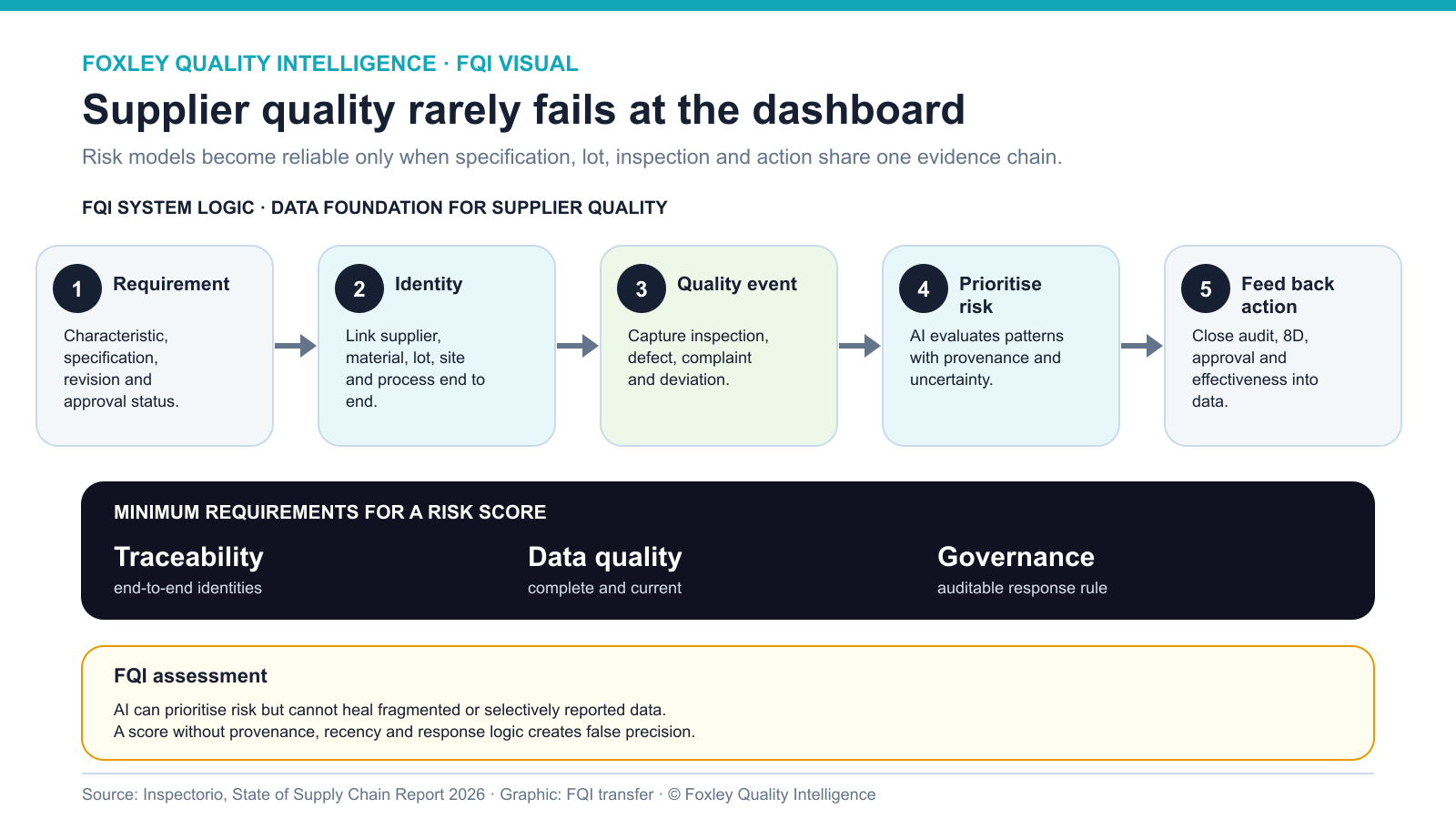
Supplier quality is a connected process. An end-product failure may originate in raw material, a sub-tier supplier, transport, drawing revision, process change or inspection error. Yet the evidence often sits in separate ERP, CAQ, MES, procurement, document and email systems. Computing power cannot repair missing identities or contradictory status logic.
The first requirement is a shared identity model. Supplier numbers, sites, materials, lots, orders, inspection lots, complaints and 8D reports must be linked unambiguously. If one supplier appears under multiple names or a complaint cannot be tied to a material lot, the model learns organisational gaps rather than quality relationships.
Terms explained
- AI: Artificial intelligence; systems that derive patterns from data or support tasks automatically.
- MES: Manufacturing execution system; software for controlling and recording production operations.
- 8D: Eight Disciplines problem-solving method; D1 through D8 structure the team, problem, cause, actions and closure.
- CAQ: Computer-aided quality; software support for inspection planning, quality data and analysis.
- ERP: Enterprise resource planning; a system for planning and managing core business resources and orders.
Deep dive
The second requirement is temporal and semantic consistency. An audit score may belong to one site while the current shipment comes from another. An 8D report may be administratively closed while effectiveness verification is still open. A drawing revision may have been released after the production date. Without validity periods and explicit statuses, AI creates connections that look current but are technically false.
The third requirement is an end-to-end quality chain. Many failures are detected at final or incoming inspection but originate in material selection, supplier approval or an undeclared process change. A useful architecture links APQP, inspection planning, supplier evaluation, complaints, audit results and change notifications. Only then can AI identify patterns early, such as rising deviation signals at a sub-tier before visible customer impact.
A supplier risk score should not be a black box. It can be decomposed into defect frequency, severity, delivery performance, repeat failures, open actions, audit status, data recency and traceability coverage. Each contribution should expose its source and timestamp. Missing data should increase uncertainty rather than automatically improving or worsening the rating.
The response plan is as important as the score. Elevated risk may trigger tighter sampling, document review, supplier discussion or a process audit. An automatic block requires much stronger evidence and formal accountability. A practical first use case is repeat-failure retrieval: complaints, internal deviations and supplier 8Ds are linked by material, failure mode and suspected mechanism. AI proposes similar cases, while a quality engineer confirms technical equivalence.
Limitations and risks
The survey is provider-sponsored and concentrated in retail and consumer goods; automotive or electronics supply chains may have different maturity. A survey reports perceptions and associations, not causal effectiveness. Central integration can also create new risks through poor master data, broad permissions and common points of failure. Finally, risk ranking can become self-reinforcing: suppliers with better documentation may appear better than technically stronger suppliers with weaker data connectivity.
FQI conclusion
The largest AI problem in supplier quality is often not the model but a broken evidence chain. AI can only consolidate risk reliably when supplier, material, lot, inspection, defect and action are connected. The sensible maturity path is therefore: clarify identities, control data quality, define the response process—and scale AI afterwards.
Sources & transparency
- Inspectorio: AI, Traceability, and Product Integrity Are Reshaping Supply Chains – State of Supply Chain Report 2026, 2026.
- Evidence status: provider survey and industry report, not an independent scientific effectiveness study. Identity, status and response architecture are FQI interpretations.
- This article and its original visualisation were created with AI support, professionally reviewed and explicitly approved for publication on 10 August 2026.
- Approval status: First-use explanations and the glossary were reviewed by a human and approved for publication on 17 August 2026. Approved by: Johann Fischer.