
Executive summary
Term note: QMS – Quality management system; the controlled organisation of responsibilities, processes and evidence. · AI – Artificial intelligence; systems that identify patterns in data or support tasks automatically.
ISO lists the forthcoming ISO 9001 as Edition 6, stage 60.00 — under publication, with publication planned for September 2026. DIN expects the German and European edition in November. According to DIN, the final draft includes the Harmonized Structure, a clearer separation of risks and opportunities, and stronger references to quality culture and ethical behaviour. Organisations should prepare a structured gap analysis now, but change processes and documents only after a robust comparison between requirements and the current system.
FQI takeaway
- State the status precisely: The standard has not yet been published but is in the final production stage. ISO 9001:2015 remains the current edition until it is replaced.
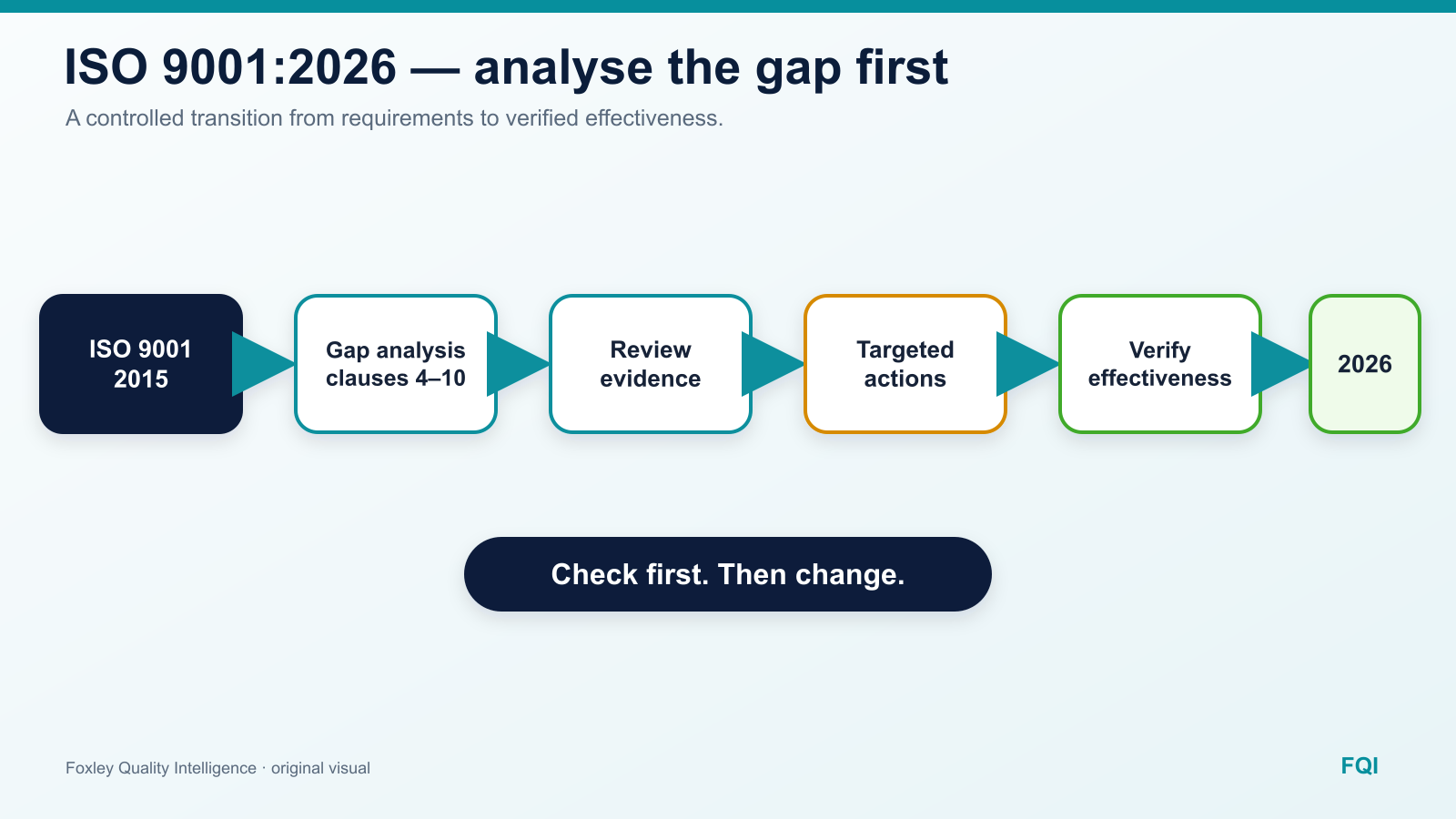
- Begin with evidence, not document volume: For every expected change, review the current process, accountable role, available evidence and actual gap.
- Control the transition as a QMS change: Gap analysis, actions, training, internal audit and management review belong in a versioned implementation plan.
The principle at a glance
Source facts
ISO shows publication stage 60.00 for the sixth edition and identifies September 2026 as the planned month. According to the lifecycle information, the final-draft vote ended on 10 July 2026. ISO announces a transition period for certified organisations but does not yet state its final duration on the product page. DIN expects DIN EN ISO 9001 in November 2026 and describes the remaining room for change after the final draft as mainly formal or editorial.
FQI interpretation
The appropriate preparation mode is controlled preliminary analysis. A QMS should not be rebuilt around headlines. Each clause should first be checked for the actual change, whether an existing arrangement already satisfies it and which effectiveness evidence is missing.
Deep dive
What ISO and DIN currently support
The revision follows the current Harmonized Structure for management-system standards. DIN also identifies a clearer treatment of risks and opportunities, integration of the 2024 climate-change amendment, a stronger connection between quality policy, organisational context and strategic direction, and requirements concerning quality culture and ethical behaviour. DIN says informative Annex A has been revised to make terminology and application easier to understand.
These points come from DIN’s explanation of the final draft. They do not replace the published standard. Exact final wording matters particularly for auditable requirements. Secondary “change lists” should therefore not become the sole target specification for the QMS.
FQI practical transfer
A robust gap analysis can use a matrix with the following fields: clause and expected change — current process — existing evidence — gap — risk — action — owner — deadline — effectiveness evidence. Clauses 4 to 10 are reviewed systematically without treating every wording change as a process deficiency.
For quality culture, the wrong response would be to write only a new policy. A more useful review asks how leadership handles competing objectives, how deviations are reported, whether bad news can be escalated without punishment and what evidence exists in decisions, audits or employee feedback. For risks and opportunities, the organisation should check whether both are genuinely identified, assessed and followed up, or whether “opportunity” has been only an extra field in a risk register.
The implementation plan should be risk-based. Critical process gaps are closed first; terminology updates can follow. Changes need training, internal audit and management review. Only demonstrated effectiveness shows that the revision has become part of the management system.
Limitations and risks
- Final publication is still pending: Timing and detailed status can change; the published edition remains authoritative.
- Not a full standards comparison: This brief reports public ISO and DIN information and does not reproduce copyrighted standard text.
- Audit interpretation will develop: Certification bodies, accreditation rules and transition guidance may further shape practical implementation.
- Document trap: Premature template changes may add bureaucracy without improving process effectiveness or evidence quality.
FQI conclusion
ISO 9001:2026 is close to publication, but good preparation does not mean rushed document maintenance. The effective route is to monitor official sources, map changes systematically, examine existing evidence, prioritise real gaps and test actions for effectiveness. Quality culture, ethical behaviour and the separate treatment of risks and opportunities deserve a process perspective rather than new boilerplate. Organisations can prepare the gap analysis now and complete it against the final published text under controlled conditions.
Sources & transparency
- ISO: ISO 9001 — Quality management systems — Requirements, Edition 6, under publication, status last reviewed 14 August 2026.
- DIN Media: Revision der ISO 9001 – Veröffentlichung 2026, including the public timetable and DIN’s description of expected final-draft changes.
- Publication status, timetable and DIN’s summary are source facts. The gap matrix, prioritisation and audit approach are FQI interpretations.
- The German source article and professional transfer were reviewed on 14 August 2026. This artificial-intelligence (AI)-assisted English translation was prepared on 17 August 2026 and awaits renewed human review. The final standard had not yet been published and will require a separate review after publication.
- Approval status: First-use explanations and the glossary were reviewed by a human and approved for publication on 17 August 2026. Approved by: Johann Fischer.