
Executive summary
Term note: AI – Artificial intelligence (AI).
When several AI agents handle one task, they can tell different stories about the source of a failure. POIROT questions the participating agents and aggregates their judgments. A study compares this approach with an individual evaluator against faults placed at known locations. Performance depends on the model and on how many faults occur together. A usable reference therefore specifies the complete set of faulty components.
FQI takeaway
- Record the responsible components before the agents diagnose a test case.
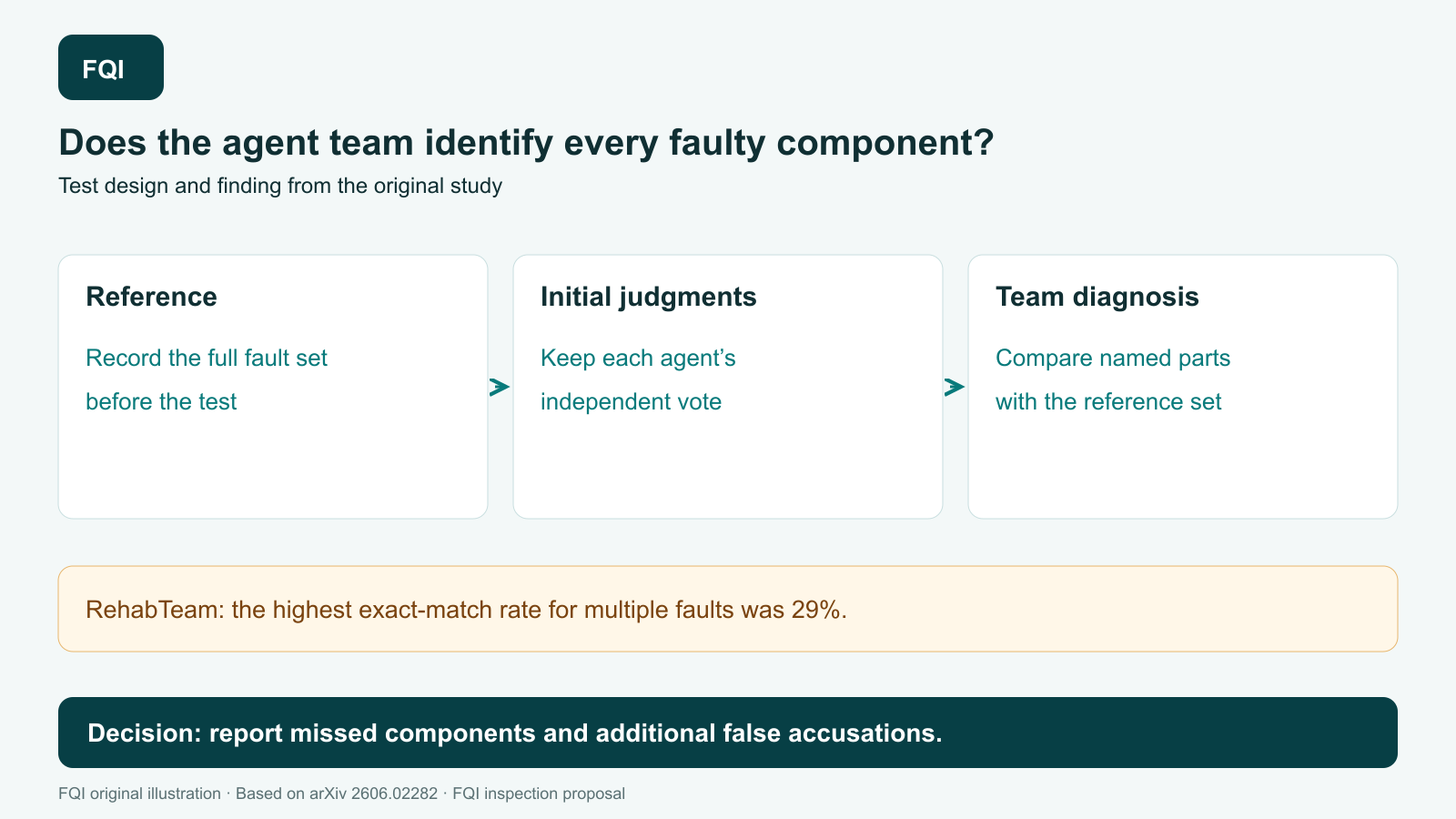
- Evaluate single and simultaneous faults separately and count extra components accused in error.
- Preserve independent initial votes to measure what later exchanges add.
The principle at a glance
A credible account of an unsuccessful interaction can persuade several observers. A diagnosis becomes testable when the team can compare the named components with an independent reference. The researchers create that reference by introducing known faults into simulated workflows. They can then compare the set of injected faults with the set of components accused at the end.
Different agents have seen different parts of the interaction. An individual evaluator reconstructs the contributions from the available record. Aggregation can bring together observations that no single participant holds. Discussion can also spread suspicion about an unusual but harmless event. The study therefore examines intermediate votes alongside the final attribution.
Deep dive
In the simulated RehabTeam system, DeepSeek V4.1 Flash achieved 42% exact attribution overall with POIROT. Its improvement over the individual evaluator was 36 percentage points for single faults and 19 points for multiple faults. The highest absolute exact-match rate in the multiple-fault condition was 29%. Counting whether a report mentioned at least one correct component would measure a much easier task.
The model comparison also matters. GPT-OSS 20B moved in the same direction, although its overall improvement was not statistically significant. With GPT-OSS 120B the individual evaluator retained a small lead in this setting. Increasing the number of participants does not by itself establish that the resulting diagnosis is more accurate for a particular system.
A second simulated environment shows why it is useful to retain intermediate votes. In some configurations, agents added an incorrect suspect while continuing to name the correct component. A measure that asks only whether the correct name appears would remain unchanged. The team acting on the diagnosis would have another component to investigate. An operational assessment can record these additional accusations as well as omitted causes.
Limitations and risks
Injected faults give a clear answer key, but capture only part of the interaction structure of a mature operational process. The results do not establish how often a real incident has several independent causes. Local tests should also include cases where an unusual observation is a downstream consequence of an earlier fault. Otherwise a convincing explanation may score well even when it points at the wrong stage.
FQI conclusion
Treat a shared diagnosis as a lead for investigation. On reference cases, check how often the entire set of named components matches the known faults. Comparing that record with the individual evaluator and the agents’ independent initial votes shows whether the extra discussion earns its place in that process.
Sources & transparency
The study is an author preprint. The proposed operational checks are FQI interpretations. POIROT: Agents as their own auditors for failure attribution in large language model multi-agent systems · Version record
- Approval status: First-use explanations and the glossary were added systematically on 15 November 2026. This version awaits renewed human review and is not approved for publication.
Codex assisted with drafting and checked the claims against the cited original sources. Johann Fischer authorized publication on 2026-11-15.