
Executive summary
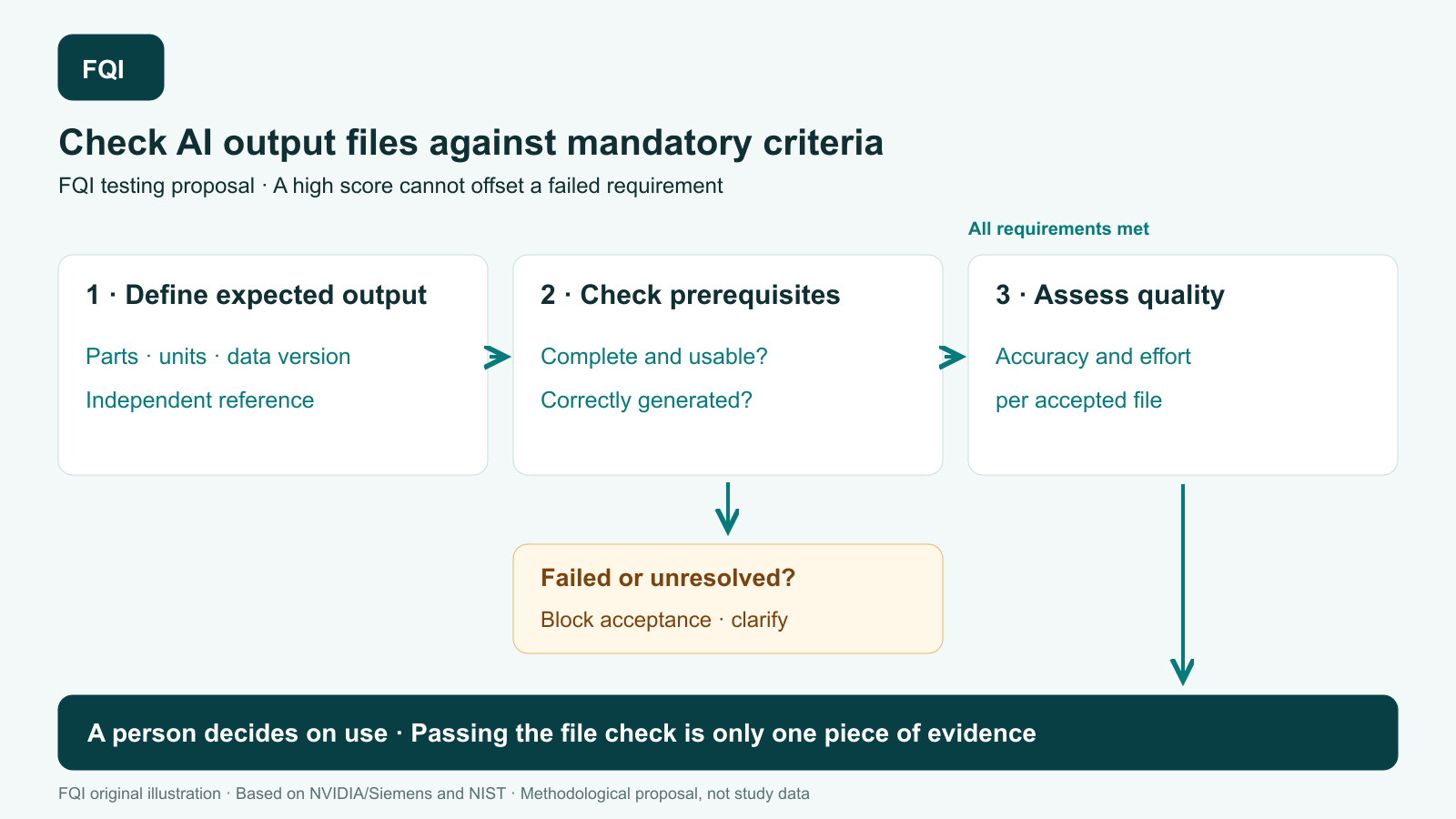
An agent using artificial intelligence (AI) can complete many steps successfully and still deliver an unusable technical file. A vendor report from chip design describes a way to inspect output. For quality management, the useful distinction is between mandatory prerequisites and graded output quality. FQI derives a bounded acceptance trial: an output must first pass every blocking criterion before accuracy and effort are assessed. This is a testing proposal, not a demonstrated performance guarantee for operational applications.
FQI takeaway
- Define mandatory criteria first: Good values elsewhere must not compensate for missing required elements.
- Test the checker itself: Deliberately damaged output files reveal whether the blocking rules actually work.
- Separate development from acceptance: Improvement on familiar tasks needs subsequent testing on unseen cases.
The principle at a glance
NVIDIA and Siemens describe an AI agent that operates tools to generate Liberty files. These files describe timing and power characteristics of logic cells. Their checker combines four gates covering completeness, usability, additional failures relative to the reference, and complete generation with the fraction of values within tolerance. If any gate fails, the score becomes zero. Optimization used two cells across 36 operating conditions in approximately 25 runs. The reported mean score rose from about 55 to 95 percent. This is not the percentage of defect-free files.
The US National Institute of Standards and Technology (NIST) recommends documented testing methods and evaluations under deployment-like conditions in its AI Risk Management Framework Playbook. This independent guidance supports the FQI proposal below, but does not confirm any vendor performance figure.
Terms explained
- AI agent: Software that divides a task into steps and operates tools using artificial intelligence.
- Blocking criterion: A prerequisite whose violation prevents acceptance.
- Reference: A technically checked comparison baseline with a documented scope of validity.
- Regression test: Repeating known checks after a change.
Deep dive
The following process is an independent FQI proposal for a pilot. As a simplified example, an agent produces an analysis file for a batch from approved measurement data. The team starts with a technical specification: which parts and characteristics belong to the batch? Which units, revision levels and associations must remain intact? Who decides what to do when data is missing? These questions define the test object before a model is assessed.
Next, the team defines blocking criteria separately from graded measures. A missing part identifier can make an association impossible and therefore block acceptance. A complete file can still contain individual values outside the agreed tolerance. Whether even one such deviation must block acceptance depends on technical criticality. An average must not replace that decision. Each blocking rule receives an owner, a checking method, an expected response and a documented policy for exceptions.
The next step tests the checking software. The team creates deliberately faulty files: an omitted part, a swapped unit, an outdated revision and a result copied from an earlier order. Correct files with unusual appearances are also needed. This makes missed errors and unjustified rejections visible separately. A checker that rejects everything would also be unsuitable.
The agent receives only the data required for its task. The responsible specialist manages the expected results and acceptance rules separately. Generated files, input versions and checking results are linked unambiguously. Passing a technical file check provides one piece of evidence within the release process; responsibility for the technical use remains explicitly assigned.
During development, known cases may be used to improve the system. For acceptance, another set is reserved beforehand, covering different batch sizes, rare combinations of characteristics and realistic data gaps. Results for the two sets are reported separately. Otherwise it remains unclear whether the system has become more robust or merely better at handling familiar examples.
The pilot report records all attempts, files passing every requirement, failures by blocking criterion and correct outputs that were wrongly rejected. Time and computational effort are additionally measured per technically accepted file. Changes to the model, work instructions, tools or checker trigger a documented regression test. When unknown errors appear, acceptance remains open until their significance has been clarified.
Limitations and risks
The technical source was written by participating vendors. The article does not provide an independent replication, a clearly identified untouched acceptance set or uncertainty intervals. Its small optimization subset does not support a general production claim. The FQI pilot was not investigated in the source. A reference can also contain errors; its suitability requires independent checking. Automated checks cannot detect every technical risk, and a green file status must not imply broader authorization.
FQI conclusion
For operational trials, the important question is whether a team can reliably recognize errors and respond appropriately. The next step is a small, independently checkable acceptance set containing normal files and deliberately faulty ones. Only when blocking behavior, false alarms and limitations are understood can the benefit be assessed. A good aggregate score remains one item of information among several. It replaces neither the individual mandatory checks nor an accountable decision about the intended use.
Sources & transparency
- NVIDIA/Siemens: Original technical report on checking generated chip-design files, October 14, 2026; complete article main text read.
- NIST: AI RMF Playbook – Measure, particularly MEASURE 2.1 and 2.3; relevant sections read.
The technical example and score are vendor-reported facts. The pilot, batch example and acceptance design are FQI interpretation. Prepared with AI assistance, checked against the cited sources and approved for publication by Johann Fischer.