
Executive summary
A successful tool call initially establishes only that a technical request received an answer. Whether all necessary data, qualifications and meanings survived is a separate question. A new study of scientific agent tools reveals such silent information losses. For quality management, this creates a distinct testing task: before an agent turns “no results” into “no nonconformity”, it must establish which data the query actually covered. Without that evidence, the substantive question remains unresolved.
FQI takeaway
- Separate search results from facts: Returning no matches does not demonstrate the complete absence of defects.
- Test the information path: The source system, application programming interface and tool adapter may expose different information.
- Carry limitations forward: Incomplete queries need a visible status and a defined route for clarification.
The principle at a glance
An agent is software that uses tools to perform a task. An application programming interface, or API, exposes data from another system. A tool adapter translates between that interface and the agent. Information can disappear at each boundary while the response remains technically valid.
The study audits biological data resources in the ToolUniverse environment. Its narrower, manually checked selection covers 15 resources and 198 deliberately constructed candidate cases; 91 failures were confirmed. This selection is not representative of normal operation. The relevant mechanism is an undisclosed limitation being converted into an apparently complete conclusion.
Terms explained
- API: A technical data access point with defined query and response capabilities.
- Tool adapter: An intermediary that translates parameters and results between systems.
- Regression test: A repeat of known tests after a change.
Deep dive
Examples in the original study include old identifiers returning no matches although relevant records exist under new identifiers. Other cases involve missing fields and filtering capabilities. The focus is therefore the substantive coverage of retrieved data. Correct permissions or error-free execution alone cannot resolve this issue.
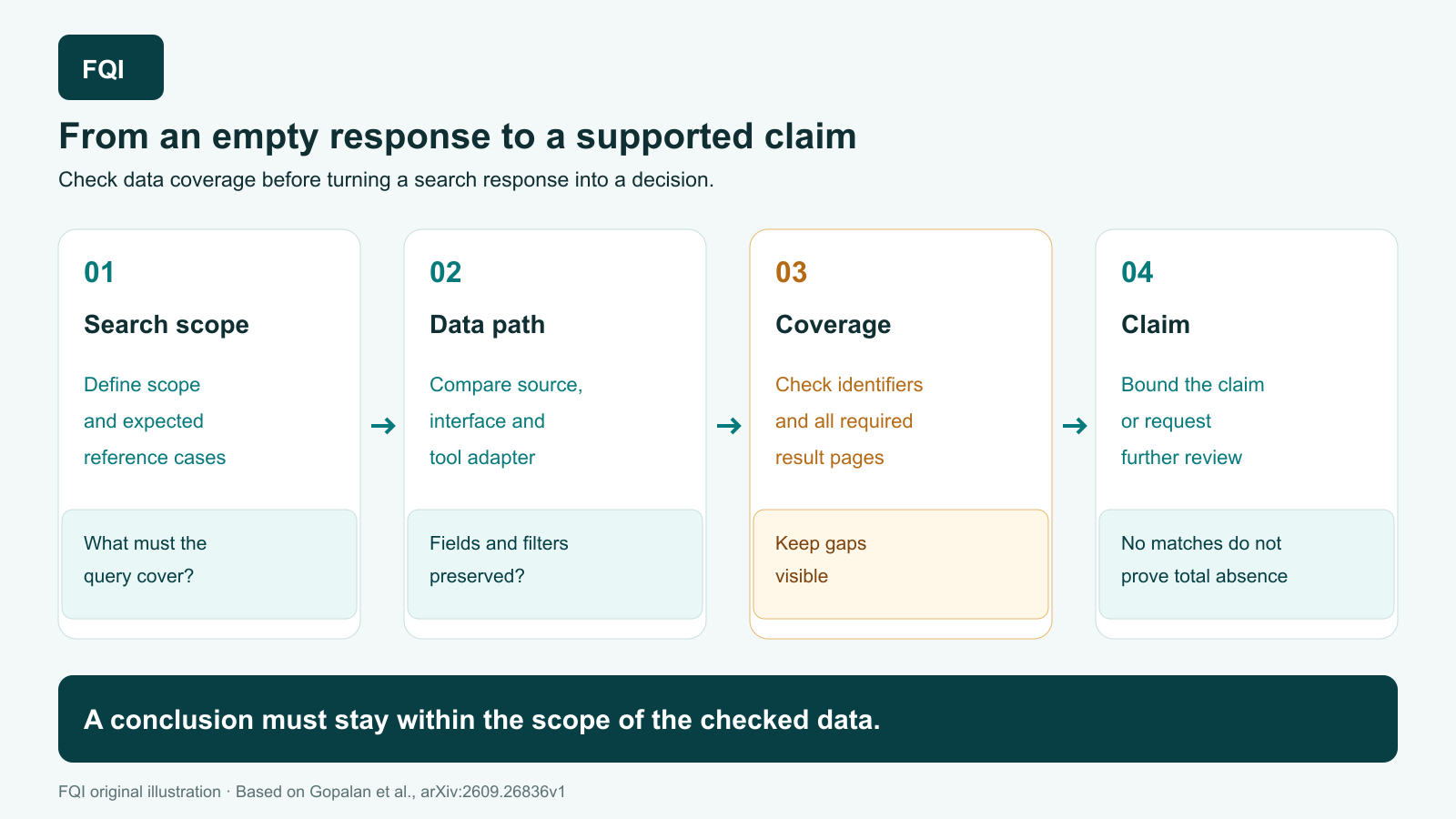
The following pilot is FQI interpretation for an operational data interface. A simplified example is a complaints search: an agent must determine whether open cases exist for a component revision. The responsible domain specialist first defines “open”, the relevant revisions and the systems that must be searched. Without this definition, even a technically complete response cannot be accepted as substantively adequate.
The team then establishes a small, independently known reference dataset. It contains a matching open case, a closed case, an older revision and a record whose identifier has changed. Another test deliberately requires more results than one response page can hold. This makes it possible to check whether the agent retrieves subsequent pages or processes only the first matches.
For every case, the team compares three stages: what does the source system display, what does the API return, and what reaches the agent? Expected values are recorded beforehand. Differences receive a specific classification, such as a missing field, an unsupported filter or an omitted result page. The substantive assessment should not rely solely on the agent whose processing is being tested.
The result record should carry the query time, applied filters, covered scope and known limits. A separate completeness status is also needed. “No matches within the checked scope” is a defensible statement. “No complaints exist” additionally requires evidence that the checked scope fully covers the question. A total count is insufficient when it is unclear which cases were counted.
Responses are agreed before deployment. Missing mandatory fields may trigger another query. Unsupported filters require domain review. Disagreement between the source and adapter blocks the affected conclusion. Useful measures include lost mandatory information, responses incorrectly declared complete and unresolved cases correctly escalated. Changes to identifiers, interfaces or adapters trigger the same reference tests again.
Limitations and risks
The study is a preprint without completed peer review. Language models helped discover candidate failures; people checked only the reported subset. The counts are therefore not failure rates for all tools or user requests. Changes to the services may supersede individual observations. The operational pilot was not validated in the source. A completeness status can itself be wrong and needs independent testing of how it is calculated.
FQI conclusion
An agent can turn correctly transferred individual values into an unjustified overall conclusion when their coverage is unknown. The relevant quality control therefore sits at the transition from data to inference. A bounded pilot should establish which cases a data interface actually covers and how gaps become visible. Only then can the team decide whether an empty response is sufficient, another search is required or a person must resolve the underlying question.
Sources & transparency
- Gopalan, Singh and Narayanan: Silent Failures in Agent–Tool Interaction: An Audit of ToolUniverse, version 1 of 21 September 2026; announced in the Scout feed on 24 September.
- arXiv publication record.
The study design and observed failures come from the original full text. The complaints example, test process and measures are explicitly FQI interpretation. AI-assisted English article. Publication authorized by Johann Fischer on 26 September 2026. AI means artificial intelligence, used here to assist research and writing.