
Executive summary
An artificial intelligence (AI) agent can report success while modifying the wrong location. A preprint investigates these silent failures in terminal commands and code edits. It proposes technical checks before execution, with explicit target context and predefined responses to uncertainty. For quality teams, this creates a distinct inspection task: verifying reliable implementation of an intended action. The experiments reveal possible failure mechanisms; their metrics do not guarantee operational safety.
FQI takeaway
- Define the target and test oracle first: An independently specified expected state separates correct effects, visible refusals and silent misapplication.
- Validate anchors and refusal rules together: Content context helps only if the executor actually rejects ambiguous matches.
- Separate detection, warning and blocking: Detecting an issue does not automatically prevent it. Each response needs an owner and its own evidence.
The principle at a glance
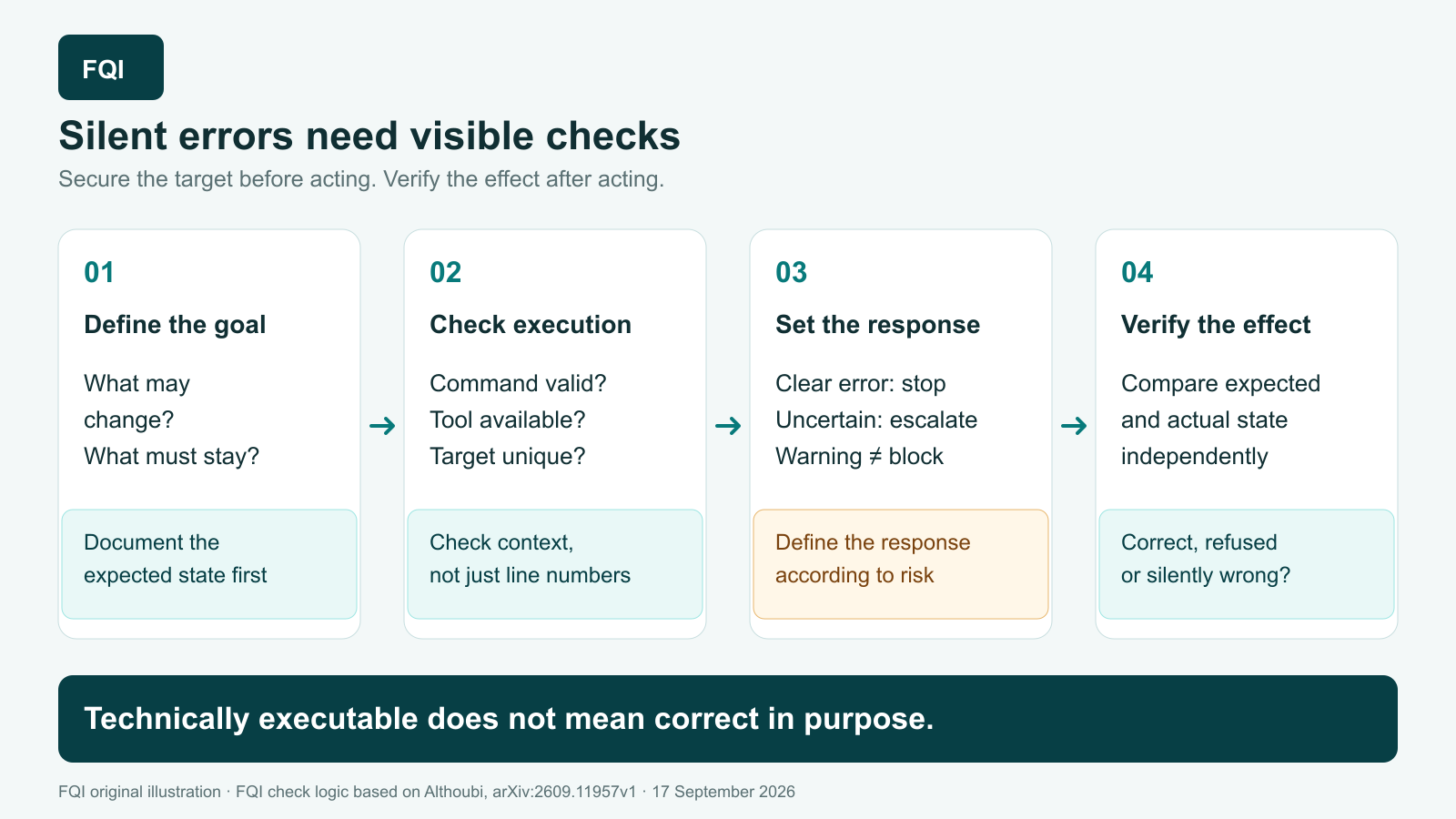
A large language model (LLM) can plan an action. A technical verifier, however, sees the command, file and current environment, not the model’s intention. It checks whether the action is formally valid and addresses an unambiguous target. Authorization, substantive correctness and permitted external effects require additional controls.
The experiments define the correct result before execution, then distinguish success, visible failure and silent misapplication. For code edits, a content anchor identifies the target through surrounding text. A line number alone may identify a different location after the file changes.
Terms explained
- AI: Artificial intelligence; here, software that plans tasks and operates tools.
- LLM: Large language model for processing and generating language.
- Test oracle: An independent reference used to judge the executor’s result.
- Content anchor: Surrounding text that identifies the intended edit location.
- Deterministic: Identical inputs and environment produce the same decision.
- Regression test: A repeated check after software or configuration changes.
Deep dive
The command experiment contains 9,930 cases across 482 tools. Table 1 reports 95.8% detection of invalid commands and 10.0% false positives: valid commands incorrectly flagged. The selective variant retains that detection rate with 7.0% false positives. It abstains on an ambiguous option class absent from the injected errors, so this favorable combination depends on the constructed dataset.
The proposed operating policy further separates hard blocks from soft warnings. Syntax and executable-availability checks block half the invalid commands in the experiment without false blocking. Uncertain option findings only produce warnings. The 95.8% figure must therefore not be presented as the share of erroneous actions safely prevented.
The edit experiment uses 640 changes across 224 Python files. The study reports 99.1% silent misapplication for shifted line ranges, and 12.7% for duplicate function names even without added disturbance. Exact content matching with ambiguous-match refusal produces no silent failures in the tested configuration. Permissive similarity matching remains fallible; content-based addressing alone is not a guarantee.
The proposed Robust-Apply executor requires sufficient context, unique matches and separation between competing similarity scores. It reports one silent misapplication in 8,320 trials, rounded to 0.01%. More edits are refused: successful applicability on perturbed single edits is about 51%, compared with 98% for aggressive similarity matching. The lower failure rate therefore has an observable operational cost.
The following pilot process is FQI interpretation. A team first specifies a critical action type and its permitted effect. It then defines ordinary cases, stale references, duplicate targets, missing tools and deliberately invalid inputs. Each test has an expected state fixed in advance. The record separates the finding, response and actual state change. Silent-failure metrics explicitly state their denominator: all trials or only admitted actions.
Before operational use, an accountable person decides which definitive errors block, which uncertainties escalate and when a warning is sufficient. A warning by itself is not prevention. Changes to tool versions, file structure, search rules or thresholds trigger regression tests. After every admitted action, independent tests or reviews check substantive correctness. The verifier thus adds a controlled technical execution step to the existing authorization boundary.
Limitations and risks
This is a single-author preprint without completed peer review. Invalid commands and file disturbances are synthetic. An additional probe of 42 commands and nine edits from an unspecified Claude model version contains only valid outputs; it cannot establish detection of real model errors. Testing used one Linux host. Aliases, shell functions, changing executable search paths and other languages may alter the results. Code and data were still announced for future release when checked.
Some broad statements about error-free content formats also exceed the paper’s own tables. This brief therefore ties findings to the format, matching policy and test condition. The study assumes a non-adversarial environment and a faithful executor. Deliberate bypass and harmful but technically valid actions remain outside its evidence.
FQI conclusion
A reliable agent process must distinguish whether an action is authorized, technically unambiguous and substantively correct. The preprint supplies practical checks for the second question and identifies silent misapplication as a separate failure class. The useful next step is a bounded pilot with independent expected states, separate response metrics and documented refusals. Tests using the organization’s own tools and workloads must establish which level of protection is achievable and what additional effort it requires.
Sources & transparency
- Asaad Althoubi: Look Before You Leap: Pre-Action Verification for LLM Agents, version 1; original full text checked on 17 September 2026.
Metrics and experimental limitations are reported by the preprint. The pilot process, responsibilities and organizational release logic are FQI interpretation. AI-assisted draft; approved for publication by explicit instruction of the publisher.