
Executive summary
An artificial intelligence (AI) model can make different decisions after technical optimization even when its weights appear unchanged. ProCerDCL examines how to assess the probability of such differences under a specified input distribution. It distinguishes acceptance, rejection and insufficient evidence for either decision. For quality managers, the scope of that evidence matters most: a positive result concerns a specific property, distribution and execution configuration. It establishes neither complete model equivalence nor freedom from errors throughout subsequent operation in a different environment.
FQI takeaway
- Define which behavioral difference is acceptable under which input distribution before testing.
- Retain inconclusive results as a separate category.
- Bind the evidence to the reference, optimized execution and technical operating conditions.
The principle at a glance
AI models are often prepared for fast execution on particular hardware. A compiler translates and optimizes their calculation steps. Limited numerical precision and changed execution order can produce small numerical differences that matter near decision boundaries.
The study compares decisions from a reference and its compiled version. One difference initially establishes different behavior. Calling that behavior technically wrong requires an additional requirement. Conversely, many matching examples alone do not establish an upper bound on undetected differences.
Deep dive
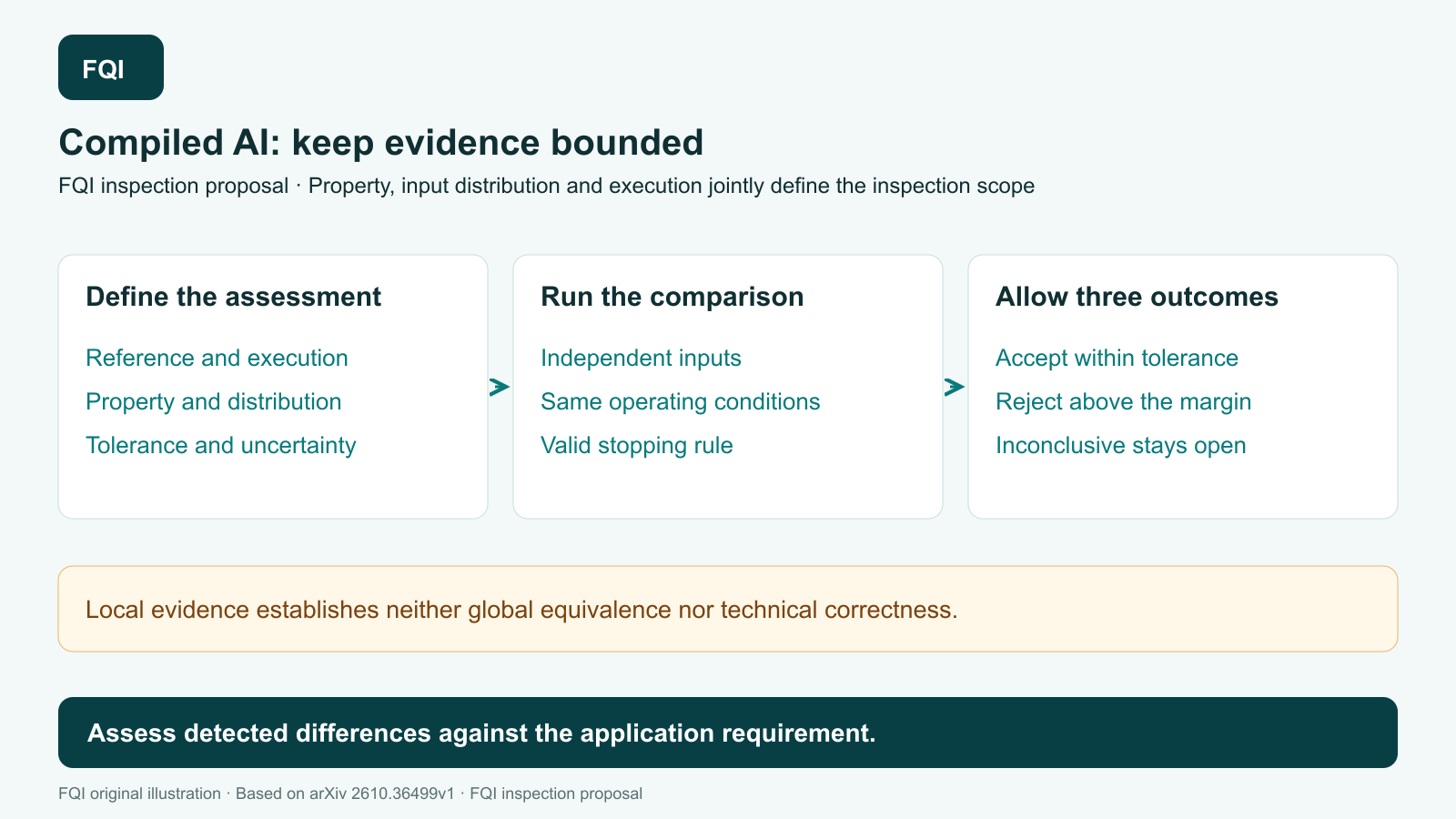
ProCerDCL formulates a statistical decision rule. A tolerated violation probability and an additional separation margin are defined in advance. Acceptance requires sufficient evidence that the probability is within tolerance. Rejection requires sufficient evidence that it exceeds the tolerance plus margin. When neither conclusion is supported, the finding remains inconclusive.
The procedure accounts for repeatedly checking whether a decision can be reached while samples are collected. An ordinary uncertainty calculation designed for one fixed evaluation time would not automatically suffice. The guarantee assumes independent samples and a checking procedure whose answer does not depend on a changing internal state.
In one investigation covering 840 input–execution-backend combinations from 21 tasks, the authors report 817 acceptances, 19 inconclusive results and four rejections. This distribution belongs to a specific local scope. It is neither a general compiler fault rate nor an acceptance rate for operational AI applications.
Experiments also show why configuration belongs to the evidence. Changing the number of inputs processed together can activate different calculation paths. Results obtained with one batch size cannot automatically be transferred to every execution. Likewise, randomly generated image perturbations are not equivalent to the distribution of real production images.
FQI proposes an inspection record with a bounded statement: which property is compared, which inputs are sampled, and which technical version does the result cover? Record tolerance, uncertainty budget, stopping limit and response rule as well. These details make acceptance auditable and prevent a local comparison from silently becoming a global claim.
A simplified FQI example concerns moving an optical classification model to a new execution environment. The team compares both versions on defined image variants. Inconclusive cases require further investigation. Established differences are then assessed against technical reference labels. Identical answers can both be wrong, while a changed answer can correct an earlier error.
Limitations and risks
The statistical guarantee applies under its stated assumptions to a fixed distribution. Repeated testing of many configurations requires separate treatment of the combined uncertainty budget. The paper does not automatically establish a valid overall guarantee for arbitrarily many searches and model versions.
Very rare differences can require millions of executions. The investigated fault examples do not measure a general detection rate. Users remain responsible for suitable starting images and operational thresholds. FQI has neither implemented the method nor reproduced its experiments.
FQI conclusion
An optimized AI execution should be assessed using a clearly bounded inspection claim. ProCerDCL shows how tolerance, statistical uncertainty and an admissible inconclusive result can be combined. In practice, binding evidence to the input distribution and execution is at least as important as a favorable metric. Additional technical assessment of detected differences determines whether a change is acceptable. A local statistical result therefore complements acceptance while leaving the broader application requirements, reference correctness and responsibility for the final decision intact.
Sources & transparency
Primary source: ProCerDCL: Query-Efficient Black-Box Probabilistic Verification of Deep Learning Compiler Optimization; original full text reviewed. Preliminary research; no independent reproduction. Methods, relevant results and limitations were assessed for this review.
Operational examples and inspection proposals are FQI interpretations. AI-assisted article, approved for publication by Johann Fischer on 2026-10-28.