
Executive summary
Artificial intelligence (AI) can generate executable software tests from requirements. A passing test initially shows only that its procedure works with the unchanged software. Req2Test-Bench examines a more demanding setting: the implementation being tested is hidden from the generating agent. Researchers subsequently assess whether its tests detect deliberately introduced faults. Quality managers gain a concrete inspection objective: requirements, test setup and fault-detection effectiveness must be traceable together. A green test run cannot replace that evidence of effectiveness within a defined scope.
FQI takeaway
- Separate requirement-based test generation from access to the implementation under test.
- Compare executability and detection of specified faults against a qualified reference.
- Examine whether a test actually exercises the required behavior and checks its result effectively.
The principle at a glance
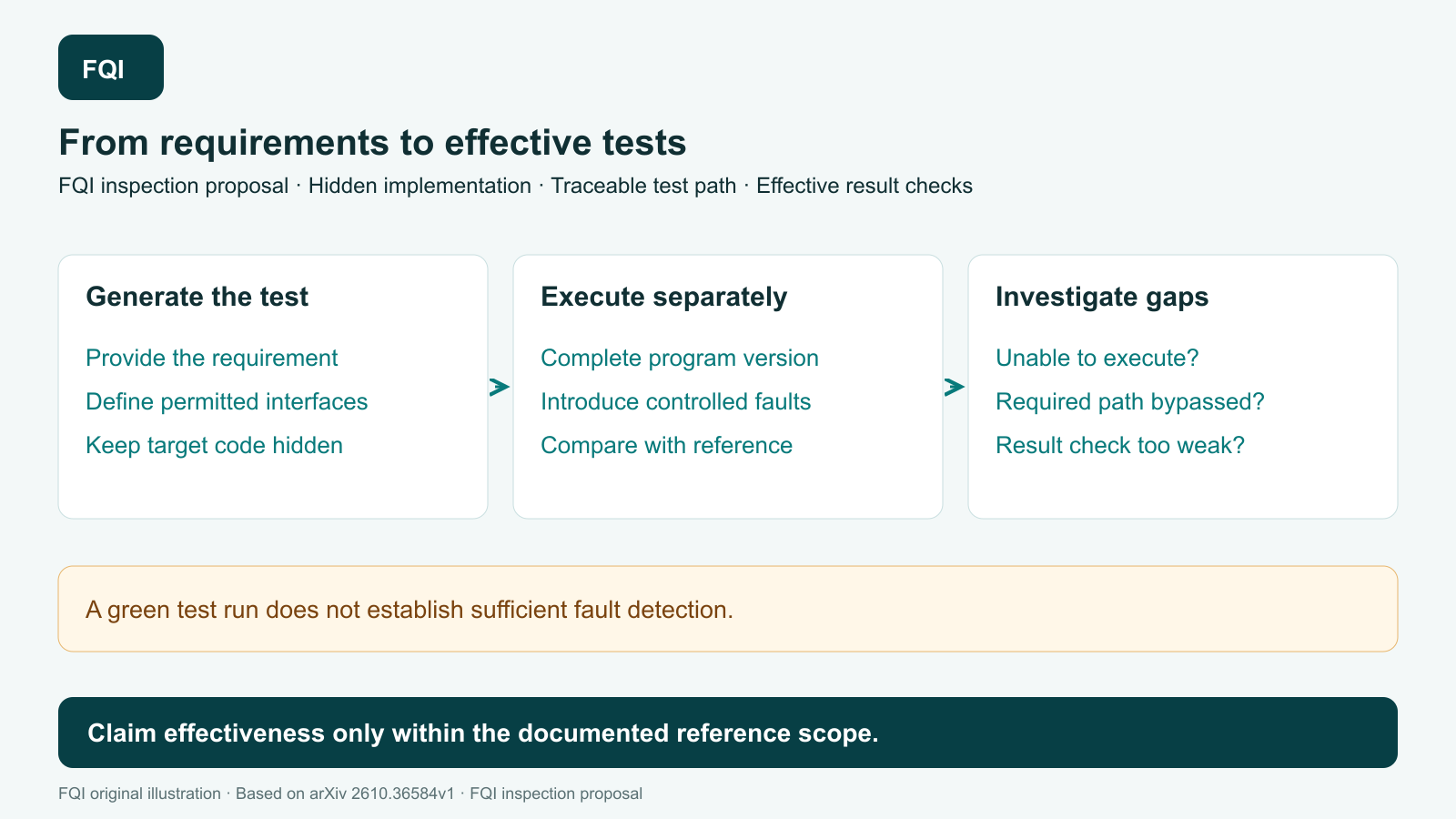
A requirement-based test describes an initial situation, an action and an expected result. The language model receives this description and the permitted interfaces. It must produce a complete test without simply copying the expected behavior from the existing program.
The study uses mutation testing to assess effectiveness. Small controlled changes are introduced into the software. A test detects a mutation when it fails after that change. Here the reference is the set of faults already detected by an existing developer test. Complete detection in this comparison therefore does not mean that every possible requirement has been secured.
Deep dive
The collection contains 5,086 execution-validated mappings between requirements and tests from eight open projects. Model evaluation uses 2,051 instances so that shared test definitions do not receive repeated equivalent weight. Two views hide either the target behavior’s implementation or all production implementations.
The configuration with the highest passing rate achieves 82.8 percent passing tests but 33.8 percent complete detection of reference mutations in the target-hidden view. These are means across projects. They describe different criteria and must not be interpreted as a general fault rate for an individual product.
The gap is not explained solely by a strict completeness rule. A relaxed requirement also leaves a substantial difference. Many incomplete tests execute faulty code but fail to check its result adequately. Others take a route that partly bypasses the required behavior. These are separate failure sources: the wrong inspection path and insufficient result checking.
For an operational pilot, FQI proposes choosing a manageable group of requirements with reliable reference tests. The assignment specifies which information the model may see and which interfaces it should use. Subsequent execution uses a separate, complete program version. This keeps generation and assessment from unknowingly relying on the same supporting artifacts.
A simplified FQI example concerns restoring a saved customer preference after a restart. A test that directly sets the expected value in its own setup may pass without testing restoration. The team must trace which step actually reads the value and which check would fail if restoration were implemented incorrectly.
The result table should distinguish at least three states: not executable, executable with incomplete fault detection, and sufficiently effective within the defined reference scope. Causes require separate responses. A missing import needs a different correction from a check that accepts an incorrect value.
Limitations and risks
Reference tests and mutation operators limit the evidence. Faults not introduced and incomplete requirements remain potential blind spots. The selected projects are not a representative industrial sample. Certain scenarios involving browsers or live services are excluded.
Hiding code also creates a particular assessment setting. Results do not transfer unchanged to every development practice. FQI reports these figures as research findings and has not run the agents or mutation tests independently.
FQI conclusion
The additional value is a traceable assessment of requirement implementation under restricted visibility. Companies should judge AI-generated tests by whether they exercise the required behavior and detect relevant deviations. Executability remains a necessary first hurdle. Sound acceptance additionally requires qualified fault cases, documented reference scope and separate analysis of the test path and result checks. This turns a collection of green tests into bounded, verifiable evidence of effectiveness for the selected requirements, while leaving untested behaviors explicitly outside that claim.
Sources & transparency
Primary source: Benchmarking LLM Agents for Behaviorally Adequate Test Generation from Software Requirements; original full text reviewed. Preliminary research; no independent reproduction. Methods, relevant results and limitations were assessed for this review.
Operational examples and inspection proposals are FQI interpretations. AI-assisted article, approved for publication by Johann Fischer on 2026-10-28.