
Executive summary
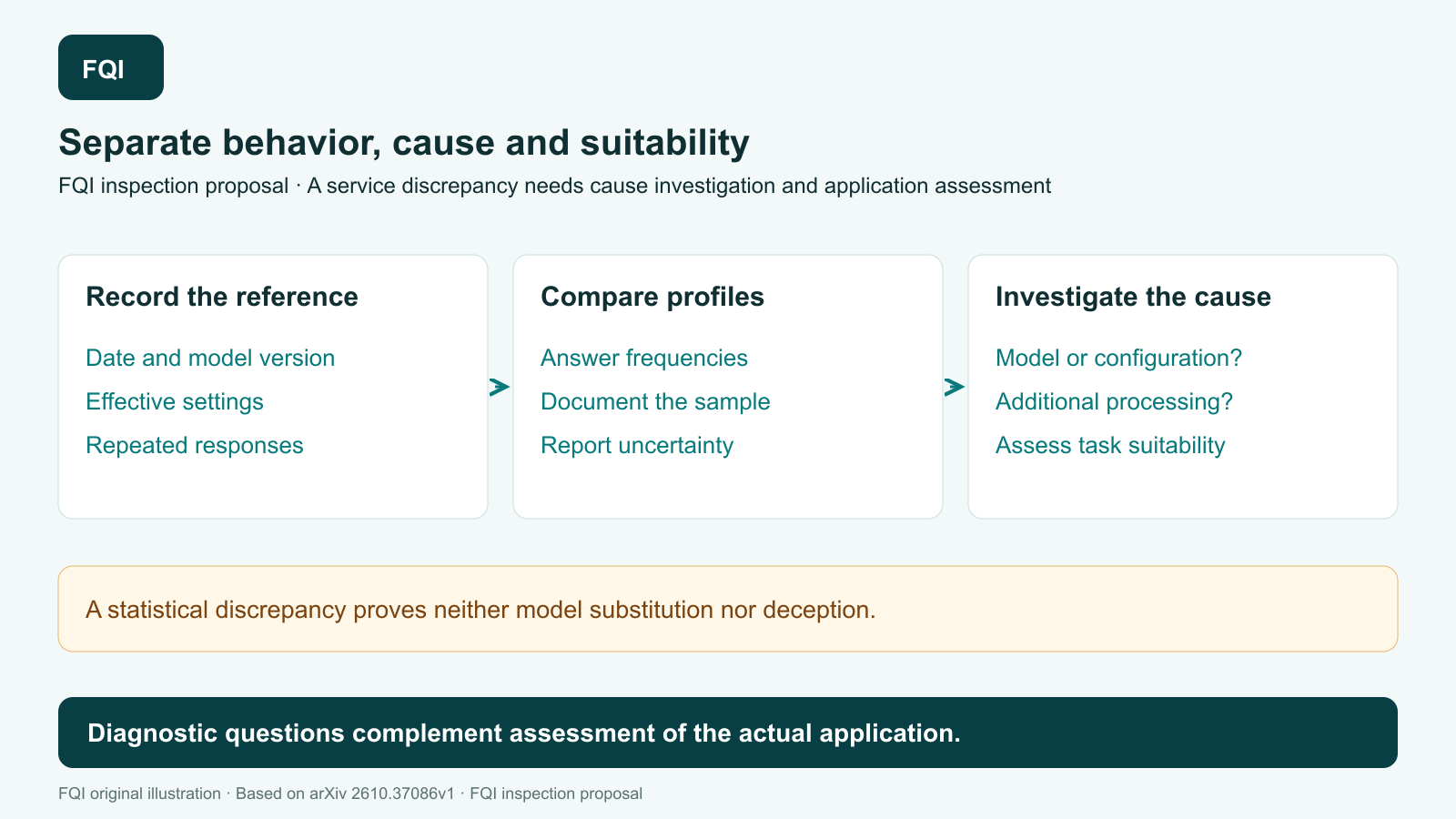
An intermediary artificial intelligence (AI) service may advertise a model name while its observable behavior differs from a trusted reference. A new study examines repeated multiple-choice questions and the distribution of their answers. The method provides statistical evidence that service endpoints differ. It proves neither model substitution nor deceptive intent. This boundary is useful for quality management: supplier assessment starts with a reproducible behavioral discrepancy and continues with a separate investigation of its cause and practical significance for the intended task.
FQI takeaway
- Compare an AI service with a documented reference under specified request conditions.
- Treat statistical discrepancy as a reason to investigate, not definitive evidence of identity.
- Check model version, configuration and upstream processing as separate possible causes.
The principle at a glance
AI can give different answers to the same question. The proposed method therefore compares frequencies across permitted answer categories rather than individual answers. Several small questions form a behavioral profile of the service.
A statistical test assesses compatibility with the reference profile. Its result depends on the questions, sample and request conditions. An unremarkable result means that this test did not detect a sufficiently strong difference. It does not confirm complete equivalence of capabilities or identify the model weights in use.
Deep dive
The study considers 16 models from ten families. The basic procedure uses five multiple-choice questions with repeated responses. Building the reference involves 1,000 responses per question; one assessed audit budget then uses 250 requests to the service under inspection. Reference construction and recurring inspection are separate cost items.
Individual questions provide statistical evidence combined into a joint result. The paper describes this as an approximate significance test. It also investigates assignment to registered model profiles and mixtures of several profiles. These extended analyses use simulations based on stored empirical distributions.
Configuration experiments are crucial for interpretation. A different system instruction or output setting can trigger a discrepancy even with the same underlying model. Additional tools, information retrieval and post-processing also affect observable behavior. The test alone cannot distinguish these causes.
FQI therefore proposes a two-stage supplier protocol. First, translate promised properties into operational terms: which model version, request parameters and additional processing belong to the agreed service? Then define a small repeatable comparison procedure. Before execution, the responsible person specifies what finding triggers investigation and how uncertainty will be reported.
A simplified FQI example is an assistant that structures inspection-report summaries. After changing provider, answer categories shift on a fixed diagnostic collection. The team should first compare versions, templates and processing. Further evidence is required to distinguish a different model from a changed configuration or workflow. Diagnostic questions do not replace a technical assessment of the report summaries themselves.
Traceability requires the reference date, sample size, valid and invalid answers, and effective settings. A reference can become outdated when its own service changes. Repeated inspections also need a predefined approach to false alarms and multiple comparisons. These operational rules are FQI proposals, not a supplier-release process validated by the study.
Limitations and risks
The method requires a trusted reference endpoint. It observes outputs only and cannot prove internal identity. A service that treats recognizable inspection requests differently from ordinary requests can weaken the connection to everyday operation.
The examined mixture estimation assumes fixed mixing proportions. It does not generally cover routing that depends on the situation. A statistically different service may still meet technical requirements, while a service without a detected discrepancy can retain important quality defects. Behavioral comparison and application suitability remain separate assessments.
FQI conclusion
The method offers an approach to AI supplier monitoring: compare observable behavior under documented conditions and escalate differences traceably. Its value lies in a bounded claim rather than presumed access to the model’s internals. Quality managers should combine reference maintenance, technical configuration checks and application-specific acceptance. Together these support a reasoned service decision. A statistical signal alone justifies neither an accusation of deception nor unrestricted acceptance, and a quiet diagnostic test cannot certify every capability that the business needs.
Sources & transparency
Primary source: Is Your LLM Relay Serving What It Claims? A low-cost and high-power test for LLM Relay Auditing; original full text reviewed. Preliminary research; no independent reproduction. Methods, relevant results and limitations were assessed for this review.
Operational examples and inspection proposals are FQI interpretations. AI-assisted article, approved for publication by Johann Fischer on 2026-10-28.