
Executive summary
A language model can change its judgment when repeatedly assessing identical material. A study using deliberately selected borderline cases shows that reducing random output selection can reduce, but not eliminate, this variation. For quality management, repeatability of an artificial intelligence (AI) reviewer is a property to measure. It cannot be inferred from configuration alone. Particularly near acceptance boundaries, individual judgments, repeated-run findings and technical resolution should remain separately traceable so that an apparently stable average does not hide inconsistent decisions on particular cases.
FQI takeaway
- Repeat assessments of identical objects under documented conditions.
- Record changing judgments per case alongside the overall average.
- Resolve unstable borderline cases using the assessment rule and a technical reference.
The principle at a glance
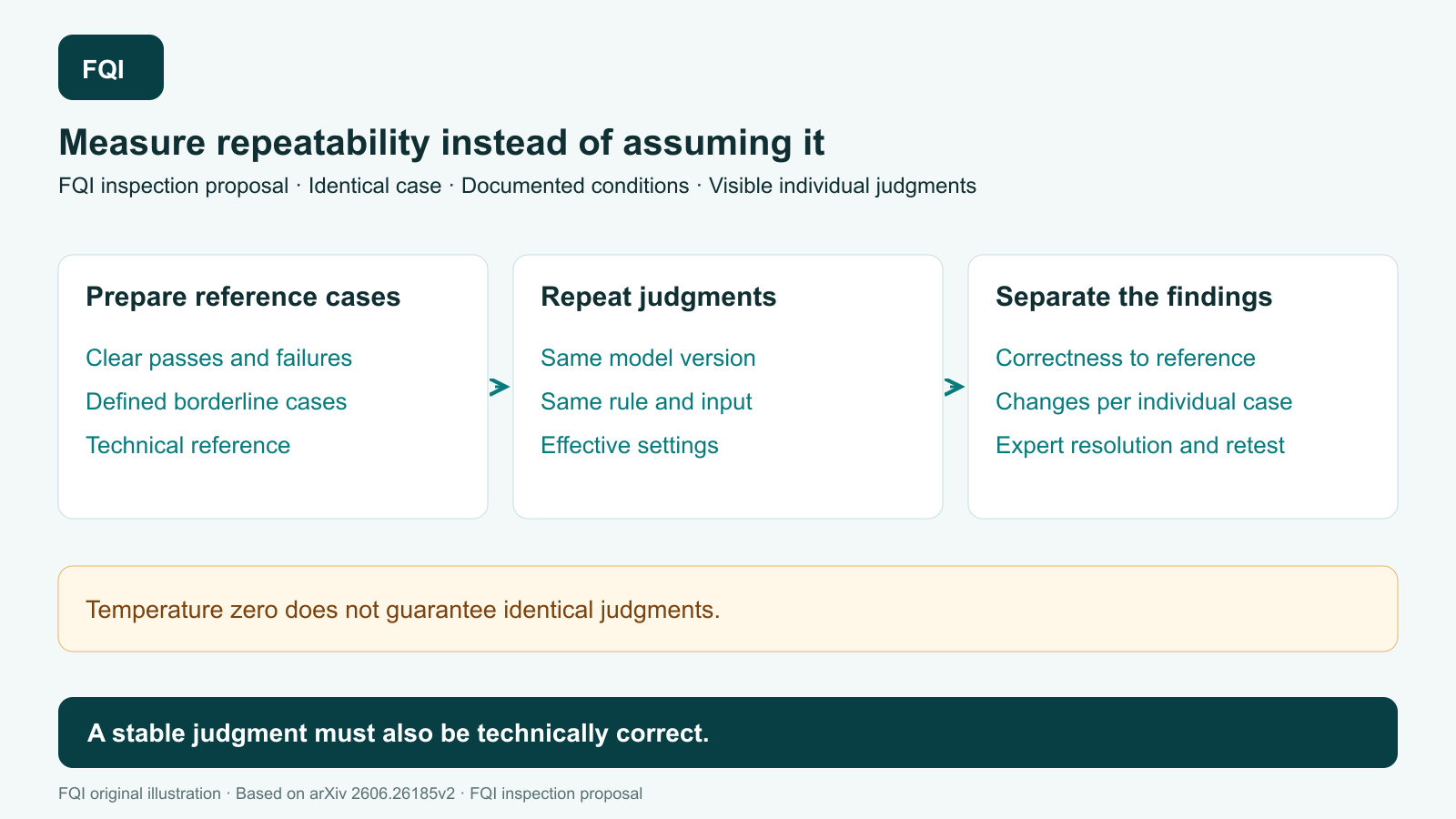
A language model acting as a reviewer reads a text and an assessment rule, then returns a decision such as pass or fail. Where supported, the temperature setting controls randomness in output selection. A value of zero is not a comprehensive guarantee of identical results across the entire technical process.
AI is used here as a measurement and assessment instrument. The team must therefore examine correctness and repeatability. A consistently wrong judgment is unusable. A changing judgment may reveal an ambiguous rule, a difficult boundary case or technical influences.
Deep dive
The preprint examines seven constructed question–answer pairs close to an assessment boundary. Each case is run 20 times under the baseline condition and ten times with temperature explicitly set to zero. For the baseline model, four of seven cases change judgment under default configuration. Two remain unstable with temperature zero.
Further conditions include additional models and settings. The study reports 690 interface calls in total. Even with a setting that permits only the most probable next output element, one borderline case remains variable in an examined model. This establishes the existence of residual variation. It determines neither its typical frequency nor the exact technical cause across all services.
The paper also traces a historical call path in open evaluation software. Important settings are not explicitly passed to the reviewer in that version. This finding is tied to the inspected software revision. It cannot be adopted as an unchecked claim about every current installation or provider.
FQI proposes dividing an operational reference collection into clearly acceptable, clearly unacceptable and technically defined borderline cases. Repeat identical inputs with the model version, assessment assignment and effective configuration recorded. Keep individual outcomes instead of reporting only their majority. This exposes changing decisions that an apparently stable aggregate might conceal.
A simplified FQI example is an assistant assessing completeness of a deviation report. A brief cause description lies near the permitted boundary. If the same report receives different judgments repeatedly, the team should first inspect the rule and its technical reference. A clearer requirement may help, but it needs renewed testing and must not be tailored solely to that one example.
Define the response rule before use. Clear, adequately qualified cases can follow their intended process. Unstable or high-risk cases receive a technical decision. Majority voting alone removes neither shared model errors nor an ambiguous assessment standard. Choose repetition counts according to the evidence objective and available effort; the small research sample is not a general prescription.
Limitations and risks
The seven cases constitute a targeted stress test rather than a representative sample. Ten or twenty repetitions cannot precisely estimate rare changes. Findings remain tied to particular models, providers and times.
Less variation also does not establish greater technical correctness. FQI did not repeat the interface calls. Provider-specific parameter statements in the paper are not presented as current product recommendations. The practical transfer is limited to qualifying and monitoring the team’s own reviewer.
FQI conclusion
An AI reviewer earns trust through documented measurement performance rather than a supposedly safe default setting. Repeated assessment of identical cases exposes an important source of error and complements comparison with technical references. Quality managers should treat changing judgments as a signal for clarification and renewed checking. Correctness, repeatability and rule clarity remain separate requirements. Considering them together supports a responsible decision about which tasks the reviewer can perform and when a person needs to intervene in the operational process.
Sources & transparency
Primary source: Necessary but Not Sufficient: Temperature Control and Reproducibility in LLM-as-Judge Safety Evaluations; original full text reviewed. Preliminary research; no independent reproduction. Methods, relevant results and limitations were assessed for this review.
Operational examples and inspection proposals are FQI interpretations. AI-assisted article, approved for publication by Johann Fischer on 2026-10-28.