
Executive summary
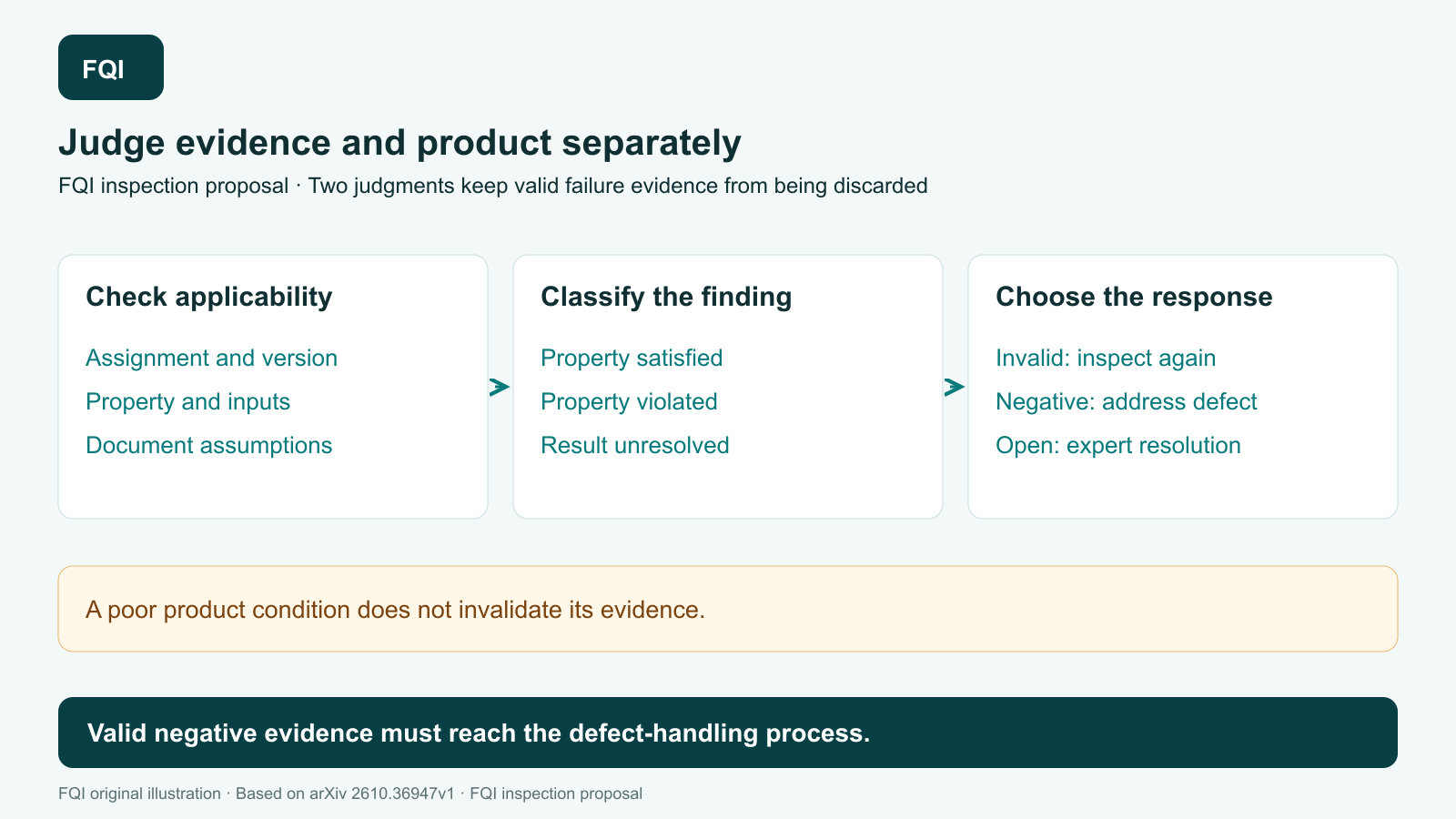
Valid evidence of a defect describes a faulty program. An artificial intelligence (AI) reviewer can confuse these two levels and reject the evidence because the software is unsafe. An exploratory study demonstrates this behavior in small language models on controlled Java tasks. Consulting several model contexts in parallel does not reliably resolve it. Quality managers therefore need a specific acceptance question: does the review process recognize sound negative evidence as reliably as it rejects irrelevant evidence of success? Evidence assessment must remain separate from the product decision.
FQI takeaway
- Assess whether evidence applies to the inspection task separately from the product condition it reports.
- Include valid counterexamples and inapplicable success reports when qualifying an AI reviewer.
- Record false acceptance, unnecessary rejection and unresolved judgments separately.
The principle at a glance
A counterexample is a concrete case that disproves a claimed property. If it demonstrates an unauthorized access in the exact program version under review, it provides valuable evidence. The appropriate conclusion is: evidence applicable, program property violated.
A technically genuine success report for another version or a restricted input range answers a different question. It cannot establish the current release claim merely because its wording sounds convincing. A language model interpreting inspection reports needs to distinguish the applicability of the report from the acceptability of the inspected object.
Deep dive
The study examines five task areas using models from one family. One particularly relevant experiment contains two sets of 120 evidence packages. Each includes 20 valid counterexamples and 100 deliberately altered packages. Depending on the experimental condition, the models reject 70–100 percent of the valid counterexamples. Examined responses assess the faulty program instead of the validity of its evidence.
A rule-based check tailored to these constructions classifies all packages correctly. Its checks include program version, inspected property, input scope and underlying assumptions. This result does not establish a universal proof checker: the discrepancies were deliberately constructed so that these checks could detect them.
Another experiment illustrates why additional information does not automatically improve decisions. On 32 tasks, raw feedback from a formal verification tool increases both correct and incorrect model judgments. The rule-based comparator additionally replays concrete failure traces. The procedures consequently do not receive evidence of identical quality. A general claim that people, AI or formal methods are superior would be unjustified.
FQI proposes a small pilot matrix with two independent axes. The first records whether the evidence applies to the inspection assignment. The second records whether it supports, violates or leaves unresolved the required property. Technically established reference cases cover these combinations. Model judgments are compared with both reference axes.
A simplified FQI example is an inspection report describing a component outside tolerance. That deviation does not invalidate the report. Conversely, a favorable report about another batch cannot justify releasing the current batch. This analogy explains the decision error; the study concerns software rather than component measurement.
Each run should have separate fields for the assignment, version reference and result. Invalid evidence calls for renewed inspection. Valid negative evidence calls for technical treatment of the defect. Distinct response paths help prevent a useful failure finding from disappearing as supposedly poor documentation.
Limitations and risks
The study is exploratory and uses small models, synthetic tasks and evidence packages designed by the authors. All unmodified packages in the relevant experiment contain counterexamples, while corrupted packages claim success. This coupling limits interpretation. A rule-based checker can also reject an unfamiliar but equivalent formulation.
FQI has not reproduced the findings. They justify targeted counterchecks, not a general performance rate for operational AI reviewers. File hashes establish identity, not the technical correctness of the evidence they identify.
FQI conclusion
An inspection process must recognize faulty products without discarding valid evidence of their defects. Companies should therefore explicitly separate evidence applicability from the conformity decision. A controlled reference collection exposes both error directions and prevents blanket rejection from making an apparently strict AI reviewer look useful. Only demonstrated performance on this distinction in the intended application can establish the model’s review role. Technical responsibility remains with the responsible inspector, including resolution of ambiguous or unsupported findings.
Sources & transparency
Primary source: Beyond QASecClaw: Agent Scaling, Verifier Feedback, and Evidence Reliability in Software Assurance; original full text reviewed. Preliminary research; no independent reproduction. Methods, relevant results and limitations were assessed for this review.
Operational examples and inspection proposals are FQI interpretations. AI-assisted article, approved for publication by Johann Fischer on 2026-10-28.