
Executive summary
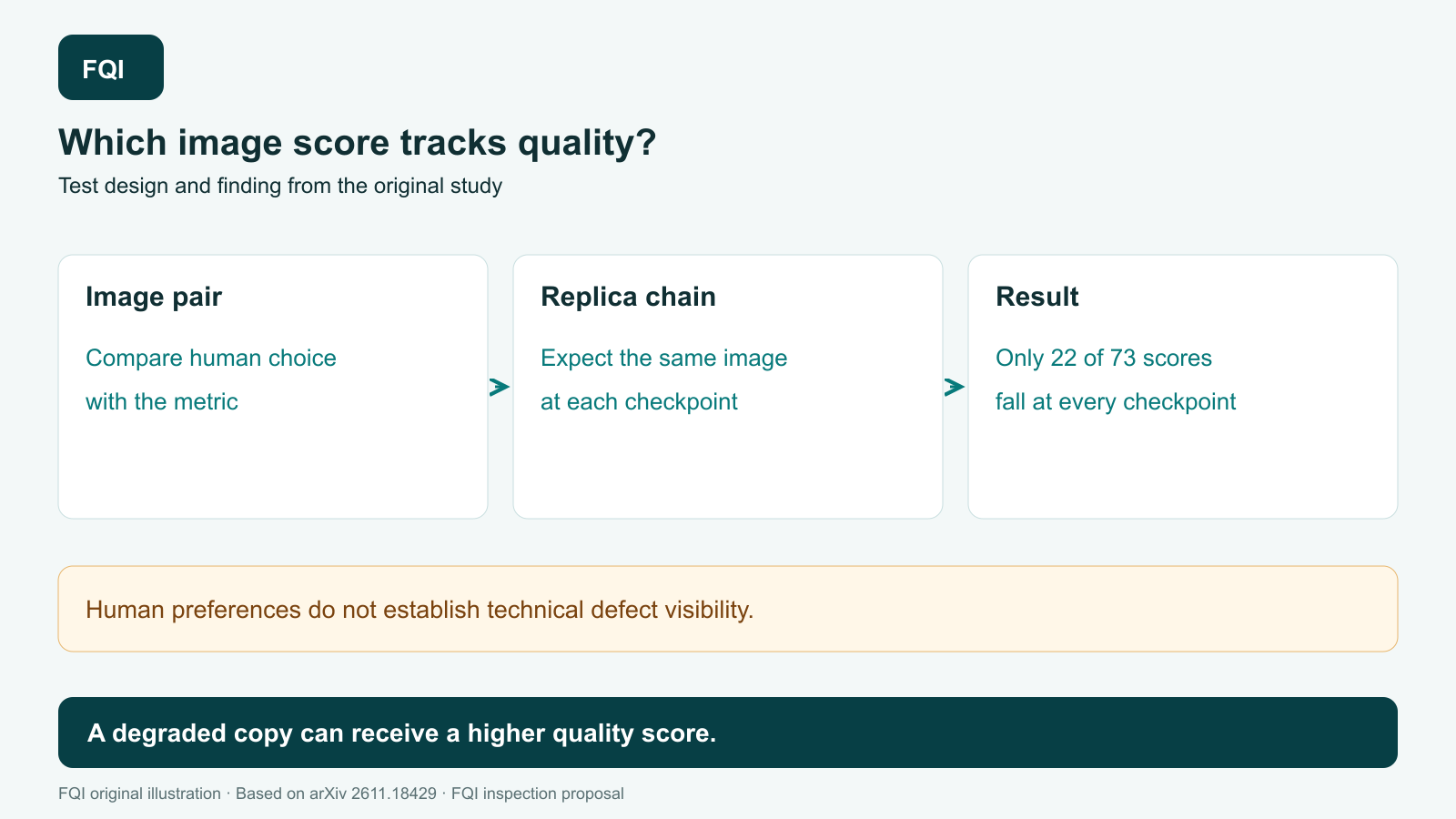
Underwater photos often lack a clean reference. When artificial intelligence enhances an image, a quality score may reward stronger contrast even when a person prefers the previous version. A study compares 73 metrics with human choices between versions of the same scene. It also follows successive generated copies that should preserve their input. Both tests reveal cases in which a score would endorse a worse image.
FQI takeaway
- Compare edits of the same scene against independently collected pairwise judgments.
- Report agreement by image collection, including the weakest result.
- Follow the score and the visible change at every checkpoint of a replica chain.
The principle at a glance
An average over unrelated photographs can conceal a wrong decision about a particular pair. A common operational choice is which of two edits of the same photograph to retain. Keeping the scene fixed makes that question testable. The study includes hand-designed metrics, learned image-quality predictors and models that process visual and language information. It assesses whether they order alternatives consistently with the reference judgments.
Deep dive
Four existing human-rating collections and a new paired study provide five references. The authors use Cohen’s kappa, an agreement measure that adjusts for choices expected to coincide by chance. Taking each metric’s weakest agreement across the five references, the best such minimum was 0.23. The median agreement between two raters in the new study was 0.41. The latter describes a separate comparison. It is neither a fixed ceiling nor a target established for all five references.
Another test repeatedly asks a generative model to reproduce an image. Noise rose by a factor of 2.5 along the reported Nano Banana Pro replica chain. Only 22 of 73 scores decreased at every checkpoint. Looking only at the endpoints could miss a step where an increasingly degraded image scored better. Simple edits could also outscore the enhancement that people preferred.
For an inspection application, prepare multiple versions of a single capture and conceal their order during human assessment. Agree beforehand what must remain visible, such as a fine line against the background. Record judgments independently of automatic scores. A disagreement produces a concrete acceptance case. Preserve that pair for subsequent model changes, since an unchanged overall average can conceal offsetting gains and losses across scenes.
One particularly informative comparison is a pair for which the score improves but the specialist can no longer distinguish the target feature. Keep the original capture, the settings of each edit and the reason for the preference together. This makes it possible to retest the same decision after the scoring method changes.
Limitations and risks
Human preferences for underwater photos do not establish the visibility of technical defects. The replica chain of one model also does not describe all image generators. A metric can still be suitable for a narrow range of scenes if the relevant decision and the consequences of a wrong ranking have been examined there.
FQI conclusion
Use the metric where it reliably selects the version suited to the task. Keep disagreeing pairs in the report. They show where an operator should inspect both images and when an apparently improved score fails to justify accepting the edited capture.
Sources & transparency
The study is an author preprint. The proposed operational checks are FQI interpretations. Do Underwater Image Quality Metrics Agree with Human Perception? A Benchmark with Human Choices, Simple Edits and Generative Drift · Version history
Codex assisted with drafting and checked the claims against the cited original sources. Johann Fischer authorized publication on 2026-11-16.